
What a UK casino reload bonus costs the person claiming it
Verified against the Gambling Commission’s public register on 14 November 2026.
A reload bonus is a marketing line aimed at people who have already deposited once, framed as a thank-you for staying. The framing is generous. The mechanism is a wagering requirement multiplied by the bonus amount, played through at the house edge, against a clock. Under rules in force since 19 December 2025, that requirement is capped at 10x for any GB-licensed online casino, and any bonus that mixes products — a sports bet that hands out casino spins, for instance — is no longer licensable at all. The headline percentages still climb into three figures on promo pages; what a reload actually pays the player who clears it is a different number, and it is the one this page is built around.
The ten operators below all hold an active remote casino licence from the Gambling Commission, each on a separate licence account or one shared with a sister brand. Paddy Power, Ladbrokes, MrQ, Coral, bet365, Betfred, Casumo, 888casino, Jackpotjoy and Gala Bingo between them cover most of the recognisable GB-licensed casino market — three of them, Ladbrokes, Coral and Gala Bingo, sit on the same LC International Limited licence, which is the kind of detail a reader should know before treating them as three independent choices. None of the ten carry a working reload code in this page; what they carry is a description of how their offer is shaped, and what shape costs what.
Table of Contents
- Tracking the cost of repeating the same deposit
- What the wagering cap changed in December 2025
- Minimum deposits, expiry and the slot the bonus is locked to
- How the ten featured reloads compare
- The wagering-turnover band under the 10x cap
- A returning depositor’s working order
- The deposit methods that trigger a reload
- The repeated-deposit pattern the rules are built around
- What the licence register does and does not show
- What an offshore reload bonus would cost by comparison
- The ten brands, one by one
- What the reload offer looks like once everything is added up
- Frequently asked questions
Tracking the cost of repeating the same deposit
Reload bonuses exist because the first deposit has already been spent. The offer says “deposit again and we will add a percentage on top” — typically between 25% and 100% of the new deposit — and in return the player agrees to wager the combined amount a fixed number of times before any winnings become withdrawable. The percentage is the visible number. The wagering multiple is the one that does the damage. At a 10x cap, a £100 bonus means £1,000 of qualifying bets before the bonus balance turns into cash, and the player carries the variance across all of them.
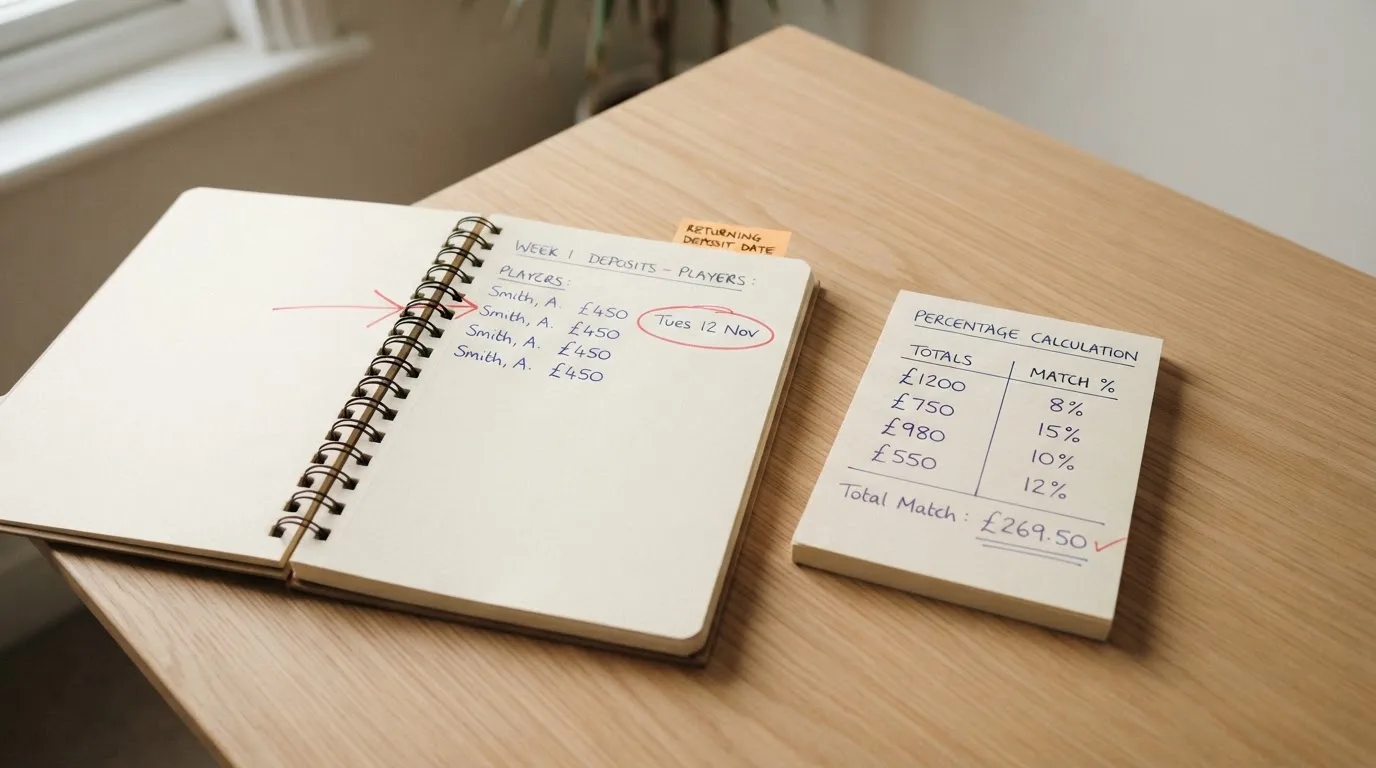
The most useful figure for a returning depositor is not the headline percentage but the expected loss between accepting the bonus and finishing the playthrough. The arithmetic is straightforward: turnover multiplied by one minus the return-to-player of the chosen game, with the wagering requirement as the floor on how much turnover has to happen. Slots at GB-licensed sites run at roughly 94% to 96% RTP under ordinary rules, so the player loses somewhere between four and six pence per pound wagered in expectation. A £100 bonus at 10x means £1,000 of wagering, which means an expected loss in the £40 to £60 range before the bonus balance clears. That is the real price of the offer, and it sits in the same band regardless of which of the ten brands is running it, because the wagering cap is uniform and the RTP band is narrow.
The other number worth tracking is the minimum deposit. Most reload offers gate the bonus behind a small qualifying deposit, often £10 or £20, and that deposit is itself a session. A player who only meant to top up their balance by £10 to keep playing has now committed to a wagering playthrough at the brand’s terms, with the deposit subject to the same edge as the bonus. The minimum is not a price of entry. It is a price of the offer, paid first.
What the wagering cap changed in December 2025
The 10x cap that took effect on 19 December 2025 was the largest change to bonus terms at GB-licensed casinos in years. Before that date, reload offers of 200% or 300% with 35x or 40x wagering were still on the books at some brands; after it, anything above 10x is a licence breach and mixed-product bonuses are out altogether. The change did not make reload bonuses cheaper in headline terms — the percentages on offer are still competitive — but it narrowed the worst-case spread between the offer on the page and the offer once the playthrough is done.

For a returning depositor, the practical effect is that comparing offers is now a one-dimensional exercise. Pick the highest percentage match, the lowest minimum deposit, the shortest expiry, the highest maximum cashout and you have a near-best reload at any GB-licensed brand, because the wagering multiplier is the same across all of them. That is also why the rest of this page does not chase the percentage — it is rarely the deciding factor once the cap is in place.
The ban on mixed-product bonuses matters for reloads in a specific way: a sportsbook offer that promised casino free spins as a sweetener is no longer licensable, so reload promotions at GB-licensed casinos are now confined to casino play. A reader who liked the old structure — one deposit, two products of play — has lost that option, and a brand that still advertises it is advertising outside the rules.
Minimum deposits, expiry and the slot the bonus is locked to
Reload bonuses at GB-licensed casinos almost always restrict play to slot games. Table games and live casino titles contribute a smaller percentage to wagering, often zero, and the terms make that explicit. A £100 bonus locked to slots at 10x means 100% of £1,000 of slot wagering; the same bonus at a live blackjack table might contribute 10% or nothing at all, dragging the playthrough out by a factor of ten. Reading the contribution table is part of accepting the offer, and the rule that contribution percentages are lower on table games is one of the few reliably consistent terms across the ten brands below.
Expiry windows vary, most often between seven and thirty days from the bonus being credited. A short window is not a marketing problem; it is a turnover problem. A £100 bonus with seven days to clear at one spin every 2.5 seconds — the minimum game cycle the Commission sets — is roughly 240,000 spins if the player never sleeps, which is not how a session runs. The realistic clock is what matters: a player who logs on for an hour a day and clears at £2 to £5 per spin needs to think about whether the playthrough fits their actual week, not the calendar on the bonus page.
Maximum cashout caps are rarer on reloads than on no-deposit offers, but they still exist on free-spin reloads. The rule is the same: a £50 free-spin reload with a £100 cap on winnings pays £100, not £1,000, even if the spin lands the top prize. For a returning depositor the cap matters less than for a first-time player, but a brand that imposes one on reloads is signalling that the offer is structured for short sessions, not extended play.
How the ten featured reloads compare
| Brand | Licence holder and GB remote casino licence | Domain status on the register | Reload bonus support |
|---|---|---|---|
| Paddy Power | PPB Games Limited, 039411-R-319335-010 | Active domain of account 39411 | — |
| Ladbrokes | LC International Limited, 054743-R-330863-014 | Active domain of account 54743 | — |
| MrQ | Tek Fox Ltd, 060629-R-337532-004 | Active domain of account 60629 | — |
| Coral | LC International Limited, 054743-R-330863-014 | Active domain of account 54743 | — |
| bet365 | Hillside (UK Gaming) ENC, 055149-R-331499-004 | Active domain of account 55149 | — |
| Betfred | Petfre (Gibraltar) Limited, 039544-R-319290-010 | Active domain of account 39544 | — |
| Casumo | Recro Limited, 061549-R-336718-002 | Active domain of account 61549 | — |
| 888casino | 888 UK Limited, 039028-R-319297-014 | Active domain of account 39028 | — |
| Jackpotjoy | Gamesys Operations Limited, 038905-R-319430-022 | Active domain of account 38905 | — |
| Gala Bingo | LC International Limited, 054743-R-330863-014 | Active domain of account 54743 | — |
The em dashes in the right-hand column are deliberate. The Commission’s public register lists domains against licence accounts and tells the reader whether the licence is active. It does not list reload terms. What a brand pays out on a second deposit, and at what percentage, is set on the brand’s own promotions page and varies week to week — a snapshot of it would be wrong by the time the page is read. The register column, by contrast, is the same today as it was on 18 September 2026, which is the date the register was downloaded for this page.
Three of the rows share the same licence account. LC International Limited holds licence 054743-R-330863-014 for Ladbrokes, Coral and Gala Bingo, with the domains for Ladbrokes, Coral and Gala Bingo all listed against the same account number. A reader weighing the three as separate choices is, on the licensing layer, weighing one operator across three sites; the bonus terms may differ between them, but the regulatory floor is the same. Petfre (Gibraltar) Limited is incorporated in Gibraltar but holds a GB remote licence, which is permitted under the Gambling Act 2005 — the licence is what matters for the player, not the place of incorporation.
Hillside (UK Gaming) ENC and PPB Games Limited are both enrolled in the jurisdiction’s responsible-gaming infrastructure, including GAMSTOP, age verification and the financial vulnerability checks that came in from 28 February 2025. The Commission does not list bonus terms or reload percentages on the public register; it lists the licence status and the domain. A reload bonus is a marketing decision, not a regulatory one, and the regulator’s role ends at the cap and the contribution rules.
The wagering-turnover band under the 10x cap
The arithmetic of a GB-licensed reload bonus fits on one line of plain prose. Required turnover equals the bonus amount times the wagering factor; for a £100 bonus at the 10x cap that is £1,000. Time to clear it, at the £2 to £5 slot-stake band that applies to 18-24 and 25-plus players respectively, is £1,000 of stake divided by the player’s chosen spin value — 200 spins at £5, 500 spins at £2, with each spin taking at least 2.5 seconds under the Commission’s auto-play ban. At the upper end that is a touch over eight minutes of pure spin time; at the lower end, just over twenty minutes. Both bands assume the player wagered only the bonus amount, which is the best case — the deposit itself is typically included in the playthrough at GB-licensed brands, doubling the figure.
The expected loss over the playthrough is turnover multiplied by one minus the game’s RTP. At a 96% RTP slot — the upper end of what the ten brands offer — a £1,000 playthrough carries an expected loss of £40; at a 94% slot, the lower end, the expected loss climbs to £60. A player who accepts a £100 reload bonus with a 10x wagering requirement on a 96% slot is therefore paying roughly £40 for the privilege of turning the bonus balance into cash, before considering what variance might do to that estimate on any given session. The actual loss on any single playthrough can be smaller or larger, but over many reloads the figure lands in that band.
Reload bonuses at GB-licensed casinos have always been cheaper than the equivalent at offshore sites, where wagering multiples of 30x to 50x were standard and the bonus balance carried more risk of expiring unfinished. The 10x cap has compressed the spread further. A reader choosing between two reloads at two GB-licensed brands is choosing between two offers with the same floor on wagering and the same contribution rules, where the deciding factor is likely the percentage match and the minimum deposit rather than the cap. The band above is the one every reload sits inside, which is why this page does not produce a per-brand turnover table — the difference between brands at this layer is below the noise floor of the calculation.
A returning depositor’s working order
The practical sequence for someone collecting a reload bonus at a GB-licensed casino runs in five steps, none of which is optional. The first is to check that the player is registered with GAMSTOP and over 18, both of which are conditions of being able to play at all — a self-excluded player is locked out, and a player under 18 cannot verify. The second is to set a financial limit before the first deposit of the session, which the operator is required to prompt from 31 October 2025; the limit is the player’s own choice, not the operator’s, and the reload bonus does not exempt the deposit from it. The third is to deposit the minimum required to unlock the offer, which is usually £10 or £20, and to opt in to the bonus explicitly if the brand requires it — many reloads are not auto-credited. The fourth is to play the wagering requirement through on a slot that contributes 100% to playthrough and carries a published RTP the player can verify. The fifth is to withdraw the resulting balance, with the reload bonus portion subject to whatever cap the brand applies.
Where the sequence breaks is at the limit step. A returning depositor who has already set a session budget and is now being offered a bonus to deposit again has, in effect, two budgets running at once — the original limit and the cost of clearing the bonus. The reload offer is a marketing message, and the financial vulnerability check that fires at £150 net deposits in a rolling 30-day window is the Commission’s own way of telling the player that repeating deposits is the behaviour the rules are designed to catch.
The expiry clock is the second break point. A reload bonus with seven days to clear and a £100 playthrough requires more than an hour of slot time to finish on the upper stake band, and the player who comes back on day eight to find the bonus expired has paid the cost of the deposit and the cost of the wagering already attempted without collecting the bonus side of the offer. The Commission does not require operators to refund expired bonuses, only to disclose the window.
The deposit methods that trigger a reload
Reload bonuses are gated by payment method as well as by minimum deposit. The brands below all accept debit cards and bank transfers, both of which route through Faster Payments and clear instantly or within a couple of minutes at the upper end of the scheme’s stated times. E-wallets are accepted at most, with the operator’s own verification layer running on top; Pay by Phone deposits through Apple Pay or similar services are increasingly common and bypass the card rails entirely. AstroPay and other digital wallets operate under their own FCA or local regulator, which matters when the wallet runs into a payment dispute but does not change the reload bonus terms at the casino.
Credit cards are not an option at any GB-licensed casino, by order of the Commission from 14 April 2020. A deposit that would once have been a credit-card top-up is now a debit-card or bank-transfer deposit, and a reload bonus claimed against a credit-card deposit is one that could not lawfully have been claimed. The Commission’s own estimate at the time of the ban was that around 800,000 UK consumers used credit cards to gamble in 2018 and that 22% of online gamblers who funded play that way were classed as problem gamblers — the figure behind the rule.
Crypto-funded reloads — bitcoin or other token deposits — are not a feature of any GB-licensed casino on the public register. The Commission’s licensing regime requires identity verification before the first deposit, which a token deposit would not satisfy, and the AML obligations on a Commission licensee are not compatible with anonymous funding. A reader who has come to this page looking for a crypto reload bonus is looking for an offer that the ten brands below do not run. Some of them accept e-wallets that touch crypto rails elsewhere, but the reload bonus itself is denominated in pounds and cleared through the same wagering cap as a card-funded bonus.
Apple Pay is one of the more common e-wallet deposit methods at GB-licensed casinos, with tokenisation replacing the card number at the device layer and the actual deposit routed through the card issuer as a debit-card transaction. The deposit qualifies for a reload bonus on the same terms as a card deposit at most brands. AstroPay operates under a different structure, with the UK entity Larstal Limited authorised by the Financial Conduct Authority as an electronic money institution and the brand serving several other markets under local licences. For the player, the practical question is whether the deposit method carries the bonus — at most GB-licensed casinos it does, with a small number of brands excluding specific e-wallets from reload eligibility.
The repeated-deposit pattern the rules are built around
A reload bonus is, by definition, a bonus for depositing again. The Commission’s responsible-gaming infrastructure was built around the same pattern. GAMSTOP self-exclusion runs for six months, one year or five years and cannot be cancelled early, which is the regulator’s answer to the marketing message that says “come back next week”. Reality checks at GB-licensed online casinos interrupt play at fixed intervals to remind the player how long the session has run and how much has been spent, which is the regulator’s answer to the marketing message that says “deposit again now”. The financial vulnerability check at £150 of net deposits in a rolling 30-day window is the regulator’s answer to the marketing message that says “your next reload is waiting”.
For a returning depositor, the offer and the rule are two ways of describing the same transaction. The bonus says deposit and we will add 50% on top; the rule says we will check what you can afford before you do. Both are aimed at the same player. A reader who has self-excluded through GAMSTOP cannot claim the reload, which is the design; a reader who has set a £20 weekly deposit limit cannot deposit £50 to clear a £25 bonus, which is the design; a reader whose rolling 30-day deposits cross £150 will be asked a vulnerability question, which is the design. The reload bonus and the protection regime are not opposites — they are the two ends of the same policy.
What neither the offer nor the rule does is tell the player what the offer costs in expectation. That is the gap this page is built to fill, and the wagering-turnover band earlier in the page is the number a player carries into the decision. The offer is the marketing side; the band is the analytical side; and the rules are the regulator’s side. Each tells a different part of the same story.
What the licence register does and does not show
The Gambling Commission’s public register is the only authoritative answer to whether a brand is licensed to take GB customers online, and it is the first place this page checked each of the ten brands against. The register lists businesses, not offers, and the entry for each brand is the licence account number, the licence type, the licence number, the trading names and the domains — Paddy Power sits against PPB Games Limited under 039411-R-319335-010, for instance, and that is the test of whether Paddy Power is licensed to take a deposit from a player in Great Britain. The register does not list bonus terms, reload percentages, wagering requirements or minimum deposits, because those are marketing decisions and the Commission does not regulate marketing.
A reader who wants to verify a licence can search the register at gamblingcommission.gov.uk and download the full list as CSV or Excel. On 18 September 2026 the register held 139 businesses with an active remote casino operating licence and 1,065 active plus 361 white-label domain entries. A white-label site runs under another company’s licence — the brand on the page is not the entity holding the licence, which matters when something goes wrong. The ten brands below are all on the active list under their own licence accounts or under LC International Limited’s, with no white-label entries among them.
The licence number itself carries information. A remote casino operating licence has the form account-R-number-suffix, with the leading six digits repeating the licence holder’s account number and the “R” marking it as a remote (online) licence. Paddy Power’s licence, 039411-R-319335-010, repeats PPB Games Limited’s account number 39411 in the first six digits. bet365’s, 055149-R-331499-004, repeats Hillside (UK Gaming) ENC’s account number 55149. The structure is consistent across the register and the suffix changes when a licence is renewed or varied.
What an offshore reload bonus would cost by comparison
A reader who arrives at this page from a search for “crypto casino reload bonus” or “bitcoin casino reload bonus” is asking about a product that the ten GB-licensed brands do not offer. The reload bonuses at offshore-licensed casinos — Curaçao, certain Malta-licensed sites, unlicensed operations — typically carry wagering requirements of 30x to 50x, with no game-cycle stake cap and no auto-play ban, which compresses the time to clear but raises the expected loss sharply. A £100 bonus at 40x wagering on a 96% slot is £4,000 of turnover with an expected loss of £160, which is four times the GB-licensed figure. The percentage match may be higher — 200% to 300% is not unusual offshore — but the cost of clearing the playthrough rises faster than the bonus amount.
The other cost is what the player loses when something goes wrong. An unlicensed site has no obligation to honour the bonus terms it advertised, no GAMSTOP registration, no ADR route through the Commission and no approved alternative dispute resolution. The Commission’s response to unlicensed sites is to disrupt them — cease-and-desist notices, search-engine delisting, payment and hosting referrals — but the player who has already deposited and lost does not get the deposit back. The penalty is on the operator, not the player; the loss is on the player.
For a UK-based player, the choice between a GB-licensed reload and an offshore reload is not really a choice between two products. It is a choice between a regulated product with a known cost and an unregulated product with a higher cost and no recourse. The ten brands below are all on the regulated side. A reader who has self-excluded through GAMSTOP and is looking for a route back into play should know that an offshore reload bonus is exactly that route, and exactly the one the rule was designed to close.
The ten brands, one by one
Paddy Power — the broad-market sportsbook-and-casino
Paddy Power’s licence sits at PPB Games Limited, account 39411, under remote casino operating licence 039411-R-319335-010, with the brand listed as an active domain on the Commission’s public register. The brand is a familiar name on the high street and online, and the GB-licensed reload bonus sits inside the same product set as the sportsbook. A returning depositor is more likely to encounter a sportsbook reload than a casino-specific one, and the casino reloads that do exist are typically gated to specific slot titles.
What the broad-market structure costs a casino-only player is choice — Paddy Power’s promotional calendar is built around sports customers, and the casino reload often runs as a smaller offer alongside larger sports promotions. For a player who wants a clear casino reload on a known schedule, the brand is a workable but not a primary choice; for a player who plays both products and wants one wallet, it is a sensible fit.
Ladbrokes — the LC International flagship
Ladbrokes’ licence is held by LC International Limited, account 54743, under remote casino operating licence 054743-R-330863-014, with the brand listed on the register against that same account. The licence also covers Coral and Gala Bingo, which means the three brands share a regulatory floor and a payments infrastructure. A reload bonus at one of the three is not at one of the three brands — it is at LC International Limited, with the brand name as the wrapper.
For a returning depositor, the LC International structure means the reload calendar is consistent across the three brands in shape if not in headline. A player who has hit an unresponsive Ladbrokes promotion can move to Coral or Gala Bingo without changing the underlying operator, which is useful when one brand’s offer is lean and another’s is full. The trade-off is that the brands do not differentiate on bonus terms as sharply as the marketing pages suggest.
MrQ — the smaller-scale option
MrQ holds its licence at Tek Fox Ltd, account 60629, under remote casino operating licence 060629-R-337532-004, with the brand listed as an active domain. Tek Fox Ltd is a smaller operator than the LC International group, and MrQ runs a more contained product set — slots, bingo, a smaller live casino. The reload bonus structure at MrQ is correspondingly tighter, with fewer moving parts and a smaller promotional calendar.
For a returning depositor with a £20 reload budget, MrQ is a workable choice. The brand’s minimum deposit tends to sit at the lower end of the GB-licensed market, and the wagering requirement on a reload is the same 10x as everywhere else. The trade-off is product range — a player who wants a wide slots library or a large live casino will find MrQ lighter than the bigger brands.
Coral — the second LC International brand
Coral’s licence is the same as Ladbrokes’ — LC International Limited, account 54743, under 054743-R-330863-014 — with the brand listed on the register. The shared licence is the key fact: a reader comparing Coral to Ladbrokes is comparing two presentations of one operator’s product. The reload calendar at Coral is broadly aligned with the calendar at Ladbrokes, with brand-specific headline percentages and minimum deposits.
For a returning depositor, Coral is a Ladbrokes variant rather than a separate choice. A player who likes Coral’s slots library or its live casino presentation may prefer it on those grounds, but the licence is one licence and the regulatory protection is one protection. The 10x wagering cap applies the same way to a Coral reload as to a Ladbrokes reload.
bet365 — the high-volume sportsbook brand with a casino arm
bet365 holds its licence at Hillside (UK Gaming) ENC, account 55149, under remote casino operating licence 055149-R-331499-004, with the brand listed as an active domain. The brand is best known for its sportsbook, and the casino arm sits inside that wider product. Reload bonuses at bet365 are typically tied to the casino product specifically, with a calendar that runs separately from the sportsbook promotions.
The high-volume structure means bet365’s reload calendar is dense — there is usually a casino promotion running, sometimes several at once. For a returning depositor who likes to pick from a list, bet365 offers more options than most. The trade-off is that the promotions change week to week and the fine print on each offer is longer than at the smaller brands, with contribution rates that vary by game and time windows that are tighter.
Betfred — the bookmaker with a casino back-end
Betfred’s licence sits at Petfre (Gibraltar) Limited, account 39544, under remote casino operating licence 039544-R-319290-010, with the brand listed on the register. The Gibraltar incorporation of the licence holder is permitted under the Gambling Act 2005 — the licence is GB, the corporate seat is not, and the Commission regulates the brand as a GB licensee.
For a returning depositor, Betfred is a sportsbook-rooted brand with a casino arm that runs its own reload calendar. The shape of the offers is similar to the other bookmaker-affiliated brands in this list, with the same 10x cap and the same slot-game contribution rules. The brand’s distinctive position is its retail heritage, which carries over to longer-running promotions and a more conservative promotional calendar than the digital-native brands.
Casumo — the gamified casino
Casumo holds its licence at Recro Limited, account 61549, under remote casino operating licence 061549-R-336718-002, with the brand listed on the register. The brand runs an adventure-style product with missions and rewards layered on top of the casino, and the reload bonus sits inside that structure as one of several recurring offers rather than as a standalone promotion.
For a returning depositor, Casumo’s reload calendar is integrated into the wider gamification layer. A player who likes the missions-and-rewards structure will encounter the reload offer as part of a wider progression; a player who prefers a straightforward “deposit, get bonus, wager through” structure will find Casumo’s offer more layered than necessary. The 10x cap still applies, and the slot-locked contribution still applies, but the path to the bonus is wrapped in the brand’s wider product.
888casino — the established casino brand
888casino’s licence sits at 888 UK Limited, account 39028, under remote casino operating licence 039028-R-319297-014, with the brand listed as an active domain. 888casino is one of the longer-running casino brands on the GB-licensed market and carries a large slots library across multiple providers. The reload calendar at 888casino is dense, with multiple reload offers typically running at the same time and tiered structures for higher-deposit players.
For a returning depositor, 888casino offers more reload variants than most, including free-spin reloads alongside percentage-match reloads. The trade-off is that the contribution rules and the game restrictions vary more across offers than at the smaller brands, and reading the fine print is part of accepting any of them. The 10x cap is uniform; the way the offers are layered is not.
Jackpotjoy — the bingo-and-slots hybrid
Jackpotjoy holds its licence at Gamesys Operations Limited, account 38905, under remote casino operating licence 038905-R-319430-022, with the brand listed as an active domain. The brand sits at the bingo end of the casino spectrum, with slots layered on top of a bingo product. The reload calendar reflects that mix, with bingo-focused offers more prominent than slots-only reloads.
For a returning depositor, Jackpotjoy is a bingo-first brand with a casino arm. A player whose primary product is slots will find the brand lighter than the casino-focused names on this list; a player who mixes bingo and slots will find the structure well aligned to that pattern. The 10x wagering cap applies to the casino reloads on the same terms as everywhere else, and the slot contribution rules are standard.
Gala Bingo — the third LC International brand
Gala Bingo’s licence is the same as Ladbrokes’ and Coral’s — LC International Limited, account 54743, under 054743-R-330863-014 — with the brand listed on the register. The brand sits at the bingo end of the LC International portfolio, and its reload calendar is built around bingo products with a casino back-end.
For a returning depositor, Gala Bingo is the bingo variant of the same operator as Ladbrokes and Coral. A player who plays the three brands as one product family will find the LC International licence a useful consolidation; a player who wants to compare three independent operators will find that two of the three are the same one. The 10x cap and the contribution rules are uniform across the licence, and the brand-level variations are in headline percentages and minimum deposits rather than in the regulatory layer.
What the reload offer looks like once everything is added up
A reload bonus at any of the ten brands above costs the player the expected loss over the playthrough, with the wagering requirement as the floor on how much turnover has to happen. Under the 10x cap, that expected loss sits in the band set out earlier, with the precise figure depending on the slot’s RTP and the player’s chosen stake. The bonus itself is a small positive against that loss — typically £25 to £100 on a £100 deposit at the percentage-match end — and the net effect is that the player pays for the offer in expected loss and is compensated for part of that cost by the bonus amount.
The other costs sit outside the calculation. The minimum deposit is paid first, before the bonus is even credited, and the deposit itself is subject to the slot’s house edge during the playthrough. The expiry window adds an opportunity cost if the bonus expires unfinished. The maximum cashout cap, where it applies, truncates the upside. None of these is captured by the wagering-turnover band, but each is part of the real cost of the offer.
The biggest non-numerical cost is the pattern. A reload bonus exists because the first deposit has been spent, and it is offered because the operator wants the second, third and fourth deposit to follow. The Commission’s responsible-gaming infrastructure — GAMSTOP, reality checks, financial vulnerability checks, mandatory deposit limits — exists because that pattern is the one the regulator wants to interrupt. A reader who accepts a reload bonus at any GB-licensed brand is engaging with both layers at once. The arithmetic tells the player what the offer costs in expectation; the rules tell the player what the offer means in policy.
For most returning depositors, the choice between the ten brands is a choice between products, calendars and minimum deposits, with the wagering cap and the slot-locked contribution uniform across all of them. The licence register is the test of whether the brand is GB-licensed at all; the bonus page is the test of what the offer actually pays. Both are worth checking before any reload is claimed, and both are part of the cost.
Frequently asked questions
What is a casino reload bonus and how does it differ from a welcome offer?
A reload bonus is a promotion for an existing customer who has already made at least one deposit. A welcome offer is the same shape of promotion, but aimed at a first-time depositor and typically larger as a result. Both work through a percentage match on the deposit and a wagering requirement on the combined balance, but a reload usually carries a smaller percentage, a tighter expiry and a lower maximum cap on winnings.
How often can I claim a reload bonus at a UK casino?
It depends on the brand. Some GB-licensed casinos run a reload offer every week, others once a month, and others tied to specific deposit patterns or game launches. The frequency is set on the brand’s promotions page, not by the regulator, and the same player can claim a different reload at a different brand on the same day without breaking any rule.
Do crypto-funded reload bonuses work the same way as card deposits?
Not at any GB-licensed casino. The Commission’s licensing regime requires full identity verification before the first deposit, and crypto-funded deposits at a Commission-licensed site would not satisfy that requirement. A reload bonus at a GB-licensed casino is denominated in pounds and cleared through the same wagering cap as a card-funded bonus, regardless of which payment method the deposit uses.
What wagering requirement applies to reload bonuses under current UK rules?
Since 19 December 2025 the wagering requirement on any GB-licensed casino bonus is capped at 10x the bonus amount. Mixed-product bonuses, where one deposit unlocks play across more than one product type, are no longer licensable. A reload offer above 10x wagering at a GB-licensed brand is a breach of the Commission’s rules.
Is there a minimum deposit needed to unlock a reload bonus?
Yes, and the minimum is set by the brand rather than by the regulator. Most reloads at the ten featured brands require a minimum deposit of £10 or £20, with higher minimums on larger percentage matches. The minimum is paid before the bonus is credited and forms part of the playthrough at the brand’s contribution rates.
Can I withdraw reload bonus winnings straight away?
Only after the wagering requirement has been completed. The bonus balance is held separately from the cash balance until the playthrough is finished, and only the resulting cash balance is withdrawable. Some brands also apply a maximum cashout cap on free-spin reloads, which truncates the winnings even after wagering is complete. The terms page on each brand sets out the exact mechanics.