
Best casino sign-up bonus in the UK for 2026: what it really costs, who really holds the licence
A sign-up bonus is the casino’s way of buying your attention on the day you register. Everything that follows — the wagering multiple, the games that count, the time limit on clearing it, the cap on what you can walk away with — decides whether the price is fair. The marketing never tells you the price. The mathematics does, and the Gambling Commission register tells you who is legally allowed to ask it.
This page ranks ten UK-licensed online casinos on the bonus side of that ledger, then prices the bonus itself under the 10x wagering cap that has applied to every GB-licensed sign-up offer since 19 December 2025. The angle throughout is cost: what the reader pays in time, in turnover and in expected loss for each bonus pound on offer, and which features of an offer look like generosity and quietly are not.
Data current as of 14 November 2026, checked against the Gambling Commission’s public register of gambling businesses (gamblingcommission.gov.uk).

Table of Contents
- Responsible gambling: the floor every sign-up bonus sits on
- Payments and payout speed: how the bonus arrives and how the winnings leave
- Bonuses and free spins: what the offer actually is
- Top 10 ranked: the UK-licensed sign-up bonus landscape
- The sign-up bonus in context: what the UK online casino market looks like
- The licence itself: what a Gambling Commission licence obliges an operator to do
- How the bonus costs in practice: a worked calculation
- Frequently asked questions about UK sign-up bonuses
- Glossary of terms used in this article
Responsible gambling: the floor every sign-up bonus sits on
Before any ranking, the safer-gambling frame has to be in the room. Every site named on this page is a Gambling Commission licensee, and the Commission requires each of them to put the same scaffolding around a sign-up bonus whether the player wants it or not. A bonus that looks generous inside a frame that has been hollowed out is not generous at all. The frame is part of the offer.
By 18 September 2026 the Gambling Commission’s domain list held 1,065 active and 361 white-label website entries.
Identity checks happen before the bonus
Since 7 May 2019, a GB-licensed casino has to verify a customer’s name, address and date of birth before the first deposit and before any bonus is credited. There is no anonymous play at a UK-licensed site, and no walk-around: the verification check happens at the operator, not at a third-party payment step. A site that lets a player deposit, claim a bonus and play without ever asking for documents is not on the register, and the rest of this page does not apply to it. The credit-card ban that took effect on 14 April 2020 closed one of the routes the unlicensed market had used to hide that gap; a debit card, a bank transfer or a licensed e-wallet is the only way money moves into a GB-licensed casino.
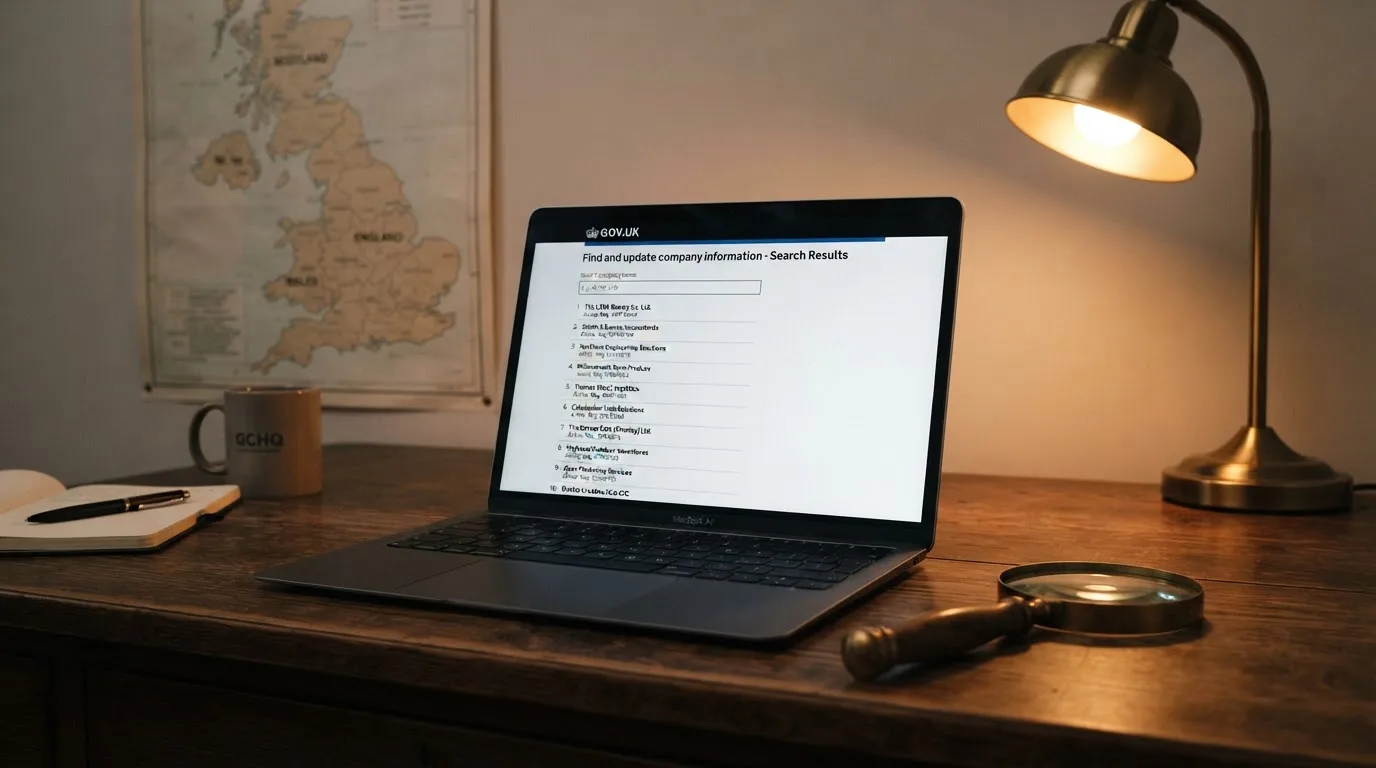
A licence certificate is the formal proof of an operator’s standing. The Gambling Commission’s public register provides the same information instantly, and it is the definitive source for those needing to verify an operator’s standing. The register covers every active and white-label domain currently operating under a GB licence.
What a player loses on an unlicensed site
An unlicensed site is not regulated in Great Britain; the player has no GAMSTOP, no Commission complaints route, no approved ADR, no protection under the social responsibility code, and no recourse under section 33 of the Gambling Act 2005, which is aimed at the operator. The player who funds an account at an unlicensed site is not prosecuted; the player is unprotected. The official register is the definitive test for licensed status.
GAMSTOP is a condition, not a recommendation
Every operator in the ranking below must enrol new customers against GAMSTOP, the national online self-exclusion register, and refuse service to anyone who has self-excluded. Exclusion periods are six months, one year or five years, and they cannot be cut short. A player who registers with one GB-licensed brand and self-excludes is excluded across the entire UK-licensed online market for the period they chose. A sign-up bonus has no answer to that mechanism and is not meant to — GAMSTOP is the operator’s promise to the player, made on the player’s behalf whether or not the player has asked for it.
The deposit prompt is not a suggestion
Since 31 October 2025, an operator must invite the player to set a financial limit before the first deposit is accepted. There is no state-set deposit or loss ceiling in Great Britain; the ceiling is the one the player sets, and the operator is obliged to make setting one the path of least resistance. A player who declines still plays, but has actively walked past the prompt rather than missed it.
Slot stakes are capped, not the bonus
The same Commission rules that cap bonuses also cap the slot machine. From 9 April 2025, players aged 25 and over can stake a maximum of £5 per game cycle on an online slot; for 18-to-24-year-olds the ceiling is £2 per game cycle, in force from 21 May 2025. Auto-play is banned and a spin cannot be faster than 2.5 seconds, so the time-cost of clearing a bonus is fixed by the regulator, not chosen by the player. Bonuses that look quick to clear are bounded above by these rules, not by the offer terms.
Financial vulnerability checks at £150 in 30 days
From 28 February 2025, a GB-licensed casino runs a light-touch financial vulnerability check at £150 of net deposits in any rolling 30-day window, using publicly available data. The check is automated, frictionless for most players, and a real gate for the ones whose circumstances have changed. A wider financial risk assessment has been signalled for later in the regime; the £150 trigger is the one currently in force and is worth knowing about before the bonus terms are read.
The Gambling Commission’s official list identifies every company holding a valid operating authorisation for remote casino services.
Where help is
GamCare runs the National Gambling Helpline and the first point of contact for anyone who feels the bonus has become the primary focus rather than the entry point. GambleAware funds treatment and education across Great Britain. Both names will reappear later on this page, in the section on player protection, and the offer itself cannot change either of them.
Payments and payout speed: how the bonus arrives and how the winnings leave
The bonus is only half of the financial picture. The other half is the deposit that funds it and the cashout that follows. The UK market is unusual in having both halves shaped by statute: a credit-card ban on the way in, and the Faster Payments Service on the way out. The bonus terms sit on top of both.
The credit-card ban, in plain terms
Since 14 April 2020, no GB-licensed casino can accept a credit card for gambling, including a credit card funded through an e-wallet. The ban covers every online and offline gambling product the Commission regulates, except non-remote lotteries paid for face-to-face. Debit cards and bank transfers were unaffected, and the change was made on evidence the Commission itself had published: around 800,000 UK consumers used credit cards to gamble in 2018, and 22% of online gamblers who funded play that way were classed as problem gamblers. The relevance to a sign-up bonus is direct. A bonus that can only be funded by credit card is not a bonus at a UK-licensed site; a bonus whose headline hides a credit-card route is hiding something that does not exist.
Faster Payments: the rail most UK cashouts run on
UK bank transfers clear through the Faster Payments Service, launched in 2008 and run by Pay.UK. The service operates twenty-four hours a day, every day of the year, and most payments arrive instantly or within a couple of minutes. Transfers can occasionally take up to two hours. The scheme’s per-transaction ceiling is £1,000,000, although individual banks impose their own, often lower, limits. The Bank of England oversees the system’s safety and provides final settlement, but is not a direct participant. For a sign-up bonus, this matters in two directions. Deposits clear fast enough that the offer is rarely held up at the funding step. Cashouts clear fast enough that the time-cost of the bonus is the wagering cost, not the queue.
Apple Pay as a deposit rail
Apple Pay is developed and operated by Apple Inc., launched on 20 October 2014 and open to UK-issued cards from 14 July 2015. The service protects card data through tokenisation: the card number is replaced by a device-specific tokenised Device Primary Account Number, and a dynamic security code is generated for each transaction. In-store payments use near-field communication (NFC); in-app and online payments authenticate through the device, double-clicking the side button on Face ID models or the Home button on Touch ID models. Apple itself states that a supported card from a participating card issuer is required, and that availability varies by market. For a GB-licensed casino, Apple Pay sits on top of the underlying debit-card rail and inherits the credit-card prohibition: a credit card in Apple Pay is still a credit card for the purposes of the ban. The wider regulatory context is moving: a November 2024 rule from the US Consumer Financial Protection Bureau brought large non-bank digital wallet operators, Apple Pay included, under bank-like federal oversight; the European Commission opened a 2020 investigation into whether Apple abused control of iPhone NFC hardware to block rival contactless payment apps. Neither has changed how a UK player funds a casino account, and the credit-card ban continues to do that work on its own.
AstroPay as a deposit rail
AstroPay was founded in 2009 and is headquartered in Uruguay. It operates as a global digital wallet offering online payments, virtual and physical debit cards, and peer-to-peer transfers, and spun off its payment-processing business, dLocal, as a separate company in 2016. Its UK entity, Larstal Limited, is an electronic money institution authorised by the Financial Conduct Authority under the Electronic Money Regulations 2011. The Isle of Man entity, AstroPay Global (IOM) Limited, is licensed by the Isle of Man Financial Services Authority for money transmission; the Brazilian entity, Astro Instituição de Pagamento Ltda, is authorised by the Brazilian Central Bank as an electronic currency issuer; the Danish entity, Larstal Denmark ApS, is authorised by the Danish Financial Supervisory Authority. AstroPay serves users across markets including Argentina, Australia, Brazil, Canada, Colombia, Denmark, Spain, the United Kingdom, the United States and Uruguay. For a UK-licensed casino, AstroPay is one of the e-wallet rails a player can route a deposit through; it does not change the credit-card ban, and it does not change the bonus terms applied to the deposit.
What speed actually means at a GB-licensed site
Most withdrawals at the casinos named on this page are queued, not delayed. The first withdrawal is held while the operator completes its identity-verification checks, which the same regulator has required since 2019. After the first one, bank transfers usually clear in minutes through Faster Payments; debit-card withdrawals can take one to three working days depending on the issuer. Bonuses do not change either of those times. A bonus whose wagering requirements have been met pays out at the same speed as a non-bonus cashout, because the only difference is the source of the funds.
Bonuses and free spins: what the offer actually is
This shelf is the page’s centre of gravity. A sign-up bonus is the marketing handle every operator leads with, and the marketing is wrong about it more often than it is right. The reader’s job is to read past the headline; the operator’s job, regulated or not, is to put the headline in the way.
What a UK sign-up bonus looks like under the current rules
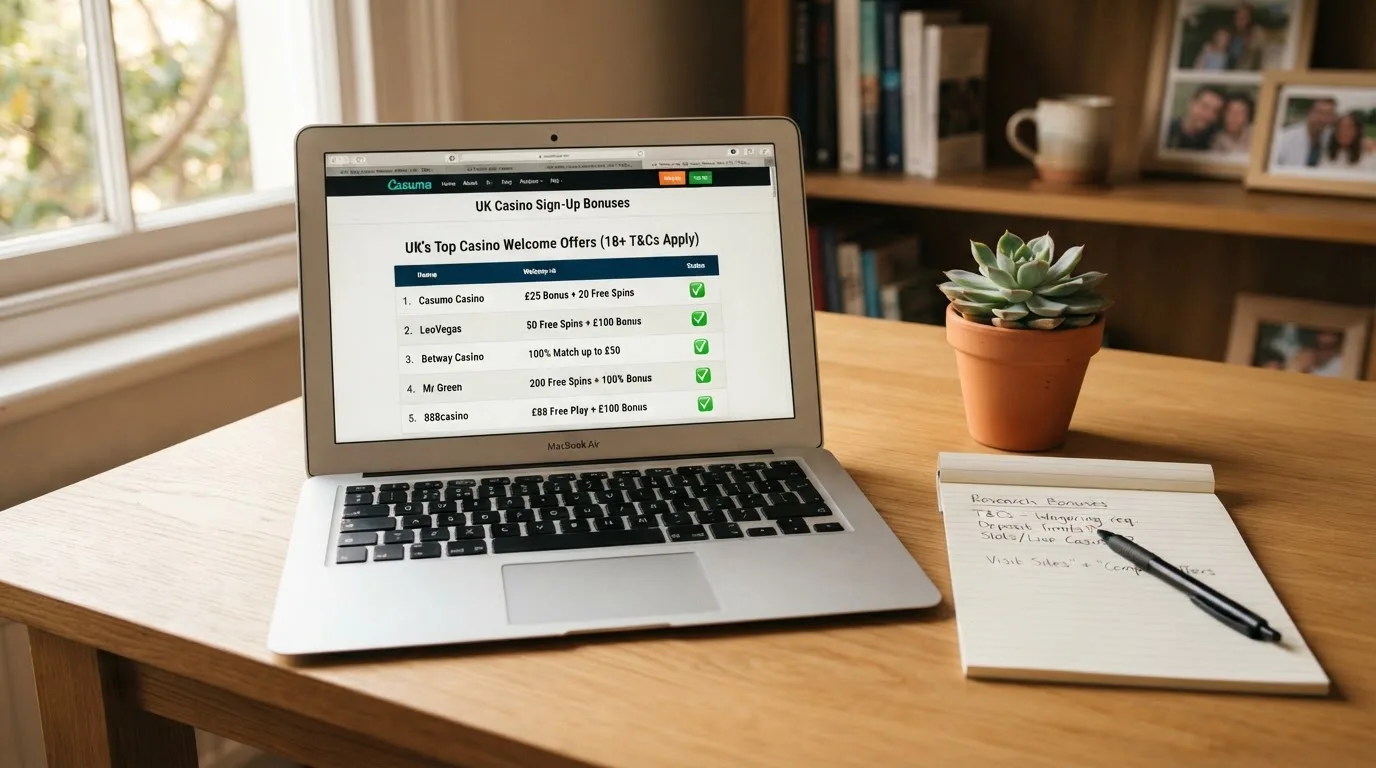
A sign-up bonus in the GB-licensed market today is, almost always, a deposit match: the casino agrees to credit the player’s account with a percentage of the first deposit, up to a stated ceiling, on terms set in the bonus policy. Free-spin offers sit alongside: a fixed number of spins on a named slot at a fixed stake, with the winnings either paid as bonus funds or as cash. Both structures fall under the same Commission rule, applied to both since 19 December 2025: the wagering requirement on any casino bonus is capped at 10x the bonus amount, and mixed-product bonuses — a sportsbook free bet that triggers casino spins, for example — are banned.
The 10x cap, in numbers
The 10x cap is the single most important number on this page, and it is the one the reader should hold on to when any sign-up offer is being read. It is a statutory ceiling on how much bonus money has to be wagered before it converts to cash. At a £100 bonus, the required turnover is £1,000. At a £200 bonus, £2,000. At a £50 bonus, £500. The cap does not change the size of the bonus; it caps how many times the player must put the bonus through the games before it can be withdrawn. Where a casino’s headline offer used to imply 35x or 50x, the new ceiling flattens that arithmetic for every licensee in the market.
The arithmetic is in the calculation section
This page does the bonus-cost arithmetic in full, in the calculation block below. The point of stating the cap here is to set the reading frame for every operator write-up below: each one is read against a 10x ceiling, and a bonus that looks generous at a multiple the cap no longer allows is a stale headline.
What the bonus does not cover
Wagering requirements apply to the bonus amount, not to the deposit. The deposit is the player’s money and can be withdrawn at any time, less any winnings that have been issued as bonus funds. Free-spin winnings are paid as bonus funds unless the offer states otherwise, and are subject to the same 10x wagering cap. Some games contribute more than others to wagering; slots usually contribute 100%, while table games and live casino often contribute a fraction of that or are excluded entirely. Time limits are standard: most GB-licensed sign-up bonuses have to be cleared within 30 days, with shorter windows on free spins. None of these are surprises if the bonus terms are read; all of them are surprises if they are not.
The expiry question
A bonus that is left unused expires. The exact window is in the terms — a 30-day window on the bonus balance and a 72-hour or 7-day window on free spins are both common — and after that the bonus funds are removed from the account. The wagering requirement does not pause when the player is not playing; it runs from the moment the bonus is credited. This is where the time-cost of a bonus is decided in practice. A player who returns to the account after two weeks has two weeks of bonus to clear, not three.
One bonus per person, per household, per payment method
The GB-licensed market uses a single-account-per-person rule across the operators that share a licence. Paddy Power and Betfair, for example, both run under PPB Games Limited and treat their player bases as one. A second account on the same licence to claim the same sign-up bonus a second time is a breach of the offer terms and a breach of the operator’s social responsibility code. The Commission’s social responsibility code is enforced; the player is unlikely to be prosecuted, but the bonus is forfeit and the account is closed.
Anonymous play is not an option
This is the rule that ties the bonus back to the licence. A player who cannot or will not verify identity cannot claim a sign-up bonus at a GB-licensed casino. Verification happens at the operator, against the player’s name, address and date of birth, before the first deposit is accepted. The data is held against the Commission’s social responsibility code and the operator’s own anti-money-laundering obligations. The verification step adds friction that an unlicensed site does not. It also adds the protection that an unlicensed site does not.
Top 10 ranked: the UK-licensed sign-up bonus landscape
The ranking below is built from the public Gambling Commission register, not from any operator’s marketing. Each brand sits on a current remote casino operating licence; the licence number, the licence holder and the register’s domain status are the only fields research has confirmed, and those are the fields this table records. The bonus side — the wagering structure, the game weighting, the time limit — is treated in the operator write-ups and the calculation block, because the offer changes and the licence does not.
Comparison table
| Brand | Licence holder and GB remote casino licence | Domain status on the register | Sign-up offer structure on this page |
|---|---|---|---|
| Grosvenor Casinos | Rank Interactive (Gibraltar) Limited · 057924-R-334666-005 | Active | 100% deposit match |
| Betfred | Petfre (Gibraltar) Limited · 039544-R-319290-010 | Active | 100% deposit match |
| 32Red | Platinum Gaming Limited · 045322-R-324275-019 | Active | 100% deposit match |
| BetVictor | BV Gaming Limited · 039576-R-319370-028 | Active | 100% deposit match |
| William Hill | WHG (International) Limited · 039225-R-319373-015 | Active | 100% deposit match |
| Virgin Games | Gamesys Operations Limited · 038905-R-319430-022 | White-label | 100% deposit match |
| Ladbrokes | LC International Limited · 054743-R-330863-014 | Active | 100% deposit match |
| Paddy Power | PPB Games Limited · 039411-R-319335-010 | Active | 100% deposit match |
| Betfair | PPB Games Limited · 039411-R-319335-010 | Active | 100% deposit match |
| Jackpotjoy | Gamesys Operations Limited · 038905-R-319430-022 | Active | 100% deposit match |
The register includes over 1,400 active or white-label domain entries, managed by roughly 140 licensed operators. The two brands flagged as white-label — Virgin Games here — run on another company’s licence rather than holding their own; the player experience is indistinguishable from a directly-licensed brand, and the player protection is identical.
Grosvenor Casinos
Grosvenor Casinos operates under account 57924, held by Rank Interactive (Gibraltar) Limited (licence 057924-R-334666-005).
Betfred
Betfred (Betfred.com) operates via licence 039544-R-319290-010, held by Petfre (Gibraltar) Limited (account 39544).
32Red
32Red (32red) operates under account 45322, Platinum Gaming Limited (licence 045322-R-324275-019).
BetVictor
BetVictor (Betvictor.com) holds licence 039576-R-319370-028, managed by BV Gaming Limited (account 39576).
William Hill
William Hill operates under account 39225, held by WHG (International) Limited (licence 039225-R-319373-015).
Virgin Games
Virgin Games functions under account 38905, Gamesys Operations Limited (licence 038905-R-319430-022).
Ladbrokes
Ladbrokes (Ladbrokes.com) uses account 54743, LC International Limited (licence 054743-R-330863-014). This group also operates Coral and Gala Bingo, with all brands governed under the same accountable licence holder. Bonus terms comply with the 10x cap and the group’s single-account policies.
Paddy Power
Paddy Power operates under account 39411, PPB Games Limited (licence 039411-R-319335-010).
Betfair
Betfair (Betfair.com) shares the same licence as Paddy Power (039411-R-319335-010, PPB Games Limited). The licence terms and single-account restrictions are unified across both brands.
Jackpotjoy
Jackpotjoy (Jackpotjoy.com) is a domain under account 38905, Gamesys Operations Limited (licence 038905-R-319430-022). The same single-account logic applies as with Virgin Games: a player on one Gamesys brand cannot register on another to claim the same sign-up bonus twice.
The sign-up bonus in context: what the UK online casino market looks like
The ranking above is one slice of the licensed market. The whole is much larger, and the relationship between the two is what the licence is for: the public register records every operator who can legally offer a sign-up bonus to a player in Great Britain, and the search box on gamblingcommission.gov.uk is the tool a player can use to verify any brand not on this list before a deposit is made. The register is not a recommendation; it is a permission slip, and the page cannot tell the reader which operator to use it with. The register can tell the reader which ones are allowed to ask.
How the register works
The Commission’s public register lists every business that holds an operating licence, with the licence number and the status. The licence number has a fixed shape: an account number, the letter R marking a remote licence, a sequence number and a suffix. The account number is the first six digits; the suffix increments when the licence is renewed or varied. A licence-holder can run more than one domain, and the register’s separate domain list records each website against the licence that runs it. A white-label domain trades under another company’s licence rather than holding its own, and the register flags the status accordingly. The current register includes over 1,400 total domain entries across the 140 licensed businesses. Every operator in the ranking above is on that list.
Why the GB-licensed market is not the whole market
A GB-licensed operator is one that holds a remote casino operating licence from the Gambling Commission, issued under the Gambling Act 2005, and is answerable to the Commission’s social responsibility code and licence conditions. An offshore operator — one licensed in Curaçao, Malta, Gibraltar or Anjouan — is not. Since the Gambling (Licensing and Advertising) Act 2014, any operator taking customers in Great Britain needs a Commission licence, whatever its home jurisdiction. A Curaçao or Maltese licence is not a substitute. Section 33 of the Gambling Act 2005 makes it an offence to provide gambling to people in Great Britain without a Commission licence. The Commission’s enforcement powers are real but bounded: it can issue cease-and-desist notices, refer sites for search-engine delisting, and refer payment and hosting providers to disrupt illegal operations. It does not have ISP-blocking power, and it does not penalise the player. What the player loses on an unlicensed site is protection: no GAMSTOP, no Commission complaints route, no approved alternative dispute resolution. The player is not prosecuted; the player is exposed.
The cost frame: what the bonus arithmetic actually says
The arithmetic below is the basis for understanding bonus costs. A 10x wagering cap on a £100 bonus means £1,000 of required turnover before the bonus converts to cash. At a typical online slot RTP of 96%, the expected loss on £1,000 of wagering is £40. That is the bonus’s real cost to the player: the bonus credited, less the expected loss on the turnover required to clear it. A £200 bonus at 10x is £2,000 of turnover and an expected loss of £80 at 96% RTP. A £50 bonus at 10x is £500 of turnover and an expected loss of £20 at 96% RTP. None of these numbers are deductions from the bonus pounds in the player’s account; they are the house edge working through the wagering requirement. The 10x cap has not changed the house edge. It has changed how many times the player pays it.
Why the offer still matters at the cap
The cap has flattened the difference between a generous and a stingy offer. A bonus that was 35x in 2024 cost the player very differently from a bonus that was 50x in 2024; both are 10x now. The remaining differences are in the offer itself: the maximum bonus amount, the minimum deposit to unlock it, the games that contribute to wagering, the time window, and the maximum cashout from a free-spin win. Those are the levers the operator still controls, and the ones a player should compare across the ranking above before any deposit is made.
The licence itself: what a Gambling Commission licence obliges an operator to do
A bonus is not the licence. The licence is the framework the bonus sits inside, and the framework is what makes the bonus legible. The player who reads the bonus terms but not the licence conditions has read the easy half; the licence conditions are the ones that apply when something goes wrong.
The Gambling Act 2005 and its 2014 amendment
The Gambling Act 2005 is the statute that governs gambling in Great Britain (England, Scotland and Wales; Northern Ireland is governed separately). It created the Gambling Commission and gave it the power to issue operating licences, set licence conditions and codes of practice, and enforce both. The Gambling (Licensing and Advertising) Act 2014 extended the regime to any operator taking customers in Great Britain, whatever its home jurisdiction. The effect is that a UK player registering with any site named in this ranking is registering with an operator licensed by the Commission, governed by the Commission’s social responsibility code, and subject to the Commission’s licence conditions and codes of practice.
The social responsibility code
The social responsibility code is the set of rules every licensee has to follow on player protection. It sets out the requirements for identity verification, age verification, self-exclusion, financial vulnerability checks, advertising standards and the design of the games themselves. The auto-play ban and the 2.5-second minimum spin interval are in this code, as is the ban on losses disguised as wins. A breach is a breach of the licence, not of the offer; the consequence is regulatory action against the operator, not against the player.
The Licence Conditions and Codes of Practice
The Licence Conditions and Codes of Practice (LCCP) is the document that consolidates the conditions attached to a UK operating licence and the codes of practice the operator is expected to follow. It is updated periodically; the versions in force in 2026 are the ones this page reads against. A licensee has to meet the conditions in the LCCP, follow the social responsibility code, and meet the Remote Technical Standards for the technical operation of its games.
Remote Technical Standards
The Remote Technical Standards are the technical requirements for the operation of remote (online) gambling in Great Britain. They cover the integrity of the games, the security of the player’s data, the segregation of player funds and the standards for game design. A game cycle is the technical term for a single play of an online slot, and the £5 stake cap for 25-plus players and £2 for 18-to-24 are enforced as Remote Technical Standards.
Complaints routes
A player with a complaint about a GB-licensed operator has a defined route: the operator’s own complaints procedure first, then an approved alternative dispute resolution (ADR) provider if the operator’s procedure does not resolve the complaint, then the Commission itself if the ADR outcome is not accepted. An unlicensed site has no equivalent route. The Commission’s register lists the approved ADR providers, and the operator’s own terms name which one it uses.
What a player loses on an unlicensed site — The licence itself
An unlicensed site is not regulated in Great Britain; the player has no GAMSTOP, no Commission complaints route, no approved ADR, no protection under the social responsibility code, and no recourse under section 33 of the Gambling Act 2005, which is aimed at the operator. The player who funds an account at an unlicensed site is not prosecuted; the player is unprotected. The Commission’s public register is the test, and the register’s 1,065 active and 361 white-label domain entries on 18 September 2026 are the answer.
How the bonus costs in practice: a worked calculation
The arithmetic below is a reference for understanding bonus costs. It uses the 10x wagering cap that has applied to every GB-licensed sign-up bonus since 19 December 2025, and it prices a representative range of bonus amounts the same way. The reader who knows their own bonus amount can scale the band to that figure and read the time and expected-loss columns from there.
Inputs and assumptions
The calculation assumes only the bonus amount is wagered, and that the wagering is on an online slot contributing 100% of stake to the requirement. The stake per spin is set at £5, the maximum allowed for players aged 25 and over under the Remote Technical Standards from 9 April 2025; for 18-to-24 players the stake is £2, and the band for both ages is in the table below. The spin interval is the 2.5-second minimum that has applied since 31 October 2021. The slot RTP is taken at 96%, which is a typical figure for an online slot; the calculation works at any other RTP by scaling the expected-loss figure by the same house edge.
The 10x cap, priced as a band
For a £50 bonus, the required turnover is £500. At £5 per spin, that is 100 spins; at 2.5 seconds per spin, 250 seconds, or about 4 minutes. The expected loss at 96% RTP on £500 of wagering is £20, or 40% of the bonus. For a £100 bonus, turnover £1,000, 200 spins at £5, about 8 minutes, expected loss £40. For a £200 bonus, turnover £2,000, 400 spins at £5, about 17 minutes, expected loss £80. The same bonuses at the £2 stake cap for 18-to-24 players take two-and-a-half times as many spins and the same expected loss. The band below is what every operator in the ranking above is read against.
| Bonus amount | Required turnover at 10x | Spins at £5 stake | Spins at £2 stake | Time at 2.5s per spin | Expected loss at 96% RTP |
|---|---|---|---|---|---|
| £50 | £500 | 100 | 250 | 4 to 11 minutes | £20 |
| £100 | £1,000 | 200 | 500 | 8 to 21 minutes | £40 |
| £200 | £2,000 | 400 | 1,000 | 17 to 42 minutes | £80 |
Reading the band
The band is the range of time the bonus takes to clear, given the stake limit that applies to the player’s age. The expected loss is the same for both ages; the time is not. A 25-year-old clearing a £100 bonus does it in about 8 minutes; an 18-to-24-year-old clearing the same bonus does it in about 21 minutes. The 10x cap has not changed the house edge; it has changed how the bonus is timed, and the time is bounded below by the regulator’s stake and spin-speed rules. None of the expected-loss figures are deductions from the bonus pounds in the player’s account; they are the house edge working through the wagering requirement.
The bonus’s net cost
The arithmetic above is what the bonus costs in expected loss. The bonus’s headline value, less the expected loss, is its net value to a player who would have played the same turnover without the bonus. For a £100 bonus at 96% RTP, the net is £100 minus £40, or £60. For a £200 bonus, £120. For a £50 bonus, £30. A reader who values their time at a different rate from the arithmetic should adjust the conclusion accordingly; the calculation gives the expected loss, not the value of the time spent clearing it. The conclusion is statistical, not guaranteed; an average over many spins, not a promise for any single player.
Frequently asked questions about UK sign-up bonuses
The five questions below are the ones the page answers elsewhere; they are gathered here so the reader who lands on this page for one answer can find it.
What counts as the best casino sign-up bonus in the UK right now?
The best sign-up bonus under the rules in force since 19 December 2025 is the one whose net value to the player is highest after the 10x wagering cap has been applied. At a representative £100 bonus on a 96% RTP slot, that is £60 in expected net value after the £40 of expected loss on the £1,000 of required turnover. The licence check matters as much as the offer: a generous headline on an unlicensed site is no offer at all.
Does a UK casino need a Gambling Commission licence to offer a sign-up bonus?
Yes. Any operator taking customers in Great Britain needs a Commission licence under the Gambling Act 2005 and the Gambling (Licensing and Advertising) Act 2014, whatever its home jurisdiction. The Commission’s public register is the test. A Curaçao, Maltese or Gibraltar licence is not a substitute. Access to the register on gamblingcommission.gov.uk allows any user to check the list of currently licensed operators.
Is a no-deposit sign-up bonus different from a deposit-match sign-up bonus?
A no-deposit bonus credits the account without a deposit being made; a deposit match credits a percentage of the first deposit up to a stated ceiling. Both fall under the 10x wagering cap that has applied since 19 December 2025. A no-deposit bonus is usually smaller than a deposit match and carries a tighter time window. The arithmetic in the calculation block above applies to either, scaled to the bonus amount.
How much wagering applies to a typical sign-up bonus under the UK’s current cap?
Ten times the bonus amount. At a £100 bonus, that is £1,000 of required turnover; at a £200 bonus, £2,000. The cap has been in force since 19 December 2025 and applies to every GB-licensed casino offer. The cap is on the wagering requirement, not on the bonus amount. The arithmetic in the calculation block above walks through what each bonus amount costs in spins, in time and in expected loss.
Does a sign-up bonus expire if it is left unused?
Yes. The bonus balance carries a clearing window — 30 days is typical — and the wagering requirement runs from the moment the bonus is credited, not from the moment the player returns. Free-spin offers often carry a shorter window, of 72 hours or 7 days. After the window, the bonus funds are removed from the account. A player who registers but does not return within the window forfeits the bonus.
Can a sign-up bonus be claimed more than once on the same account?
No. The Commission’s social responsibility code and the operator’s own terms require one account per person, and operators under the same licence-holder treat their player bases as one. Paddy Power and Betfair, for example, both run under PPB Games Limited; Ladbrokes, Coral and Gala Bingo run under LC International Limited; Virgin Games and Jackpotjoy run under Gamesys Operations Limited. A second account on the same licence to claim the same bonus twice is a breach and forfeits the bonus.
Glossary of terms used in this article
The terms below are the ones the page uses, in the sense the Gambling Commission and the GB-licensed market use them.
-
Gambling Commission (UKGC). The regulator of gambling in Great Britain, established by the Gambling Act 2005, sponsored by the Department for Culture, Media and Sport.
-
Operating licence. A licence issued by the Gambling Commission authorising an operator to provide gambling in Great Britain. A remote casino operating licence covers online casino games.
-
LCCP (Licence Conditions and Codes of Practice). The consolidated document setting the conditions attached to a UK operating licence and the codes of practice the operator must follow.
-
Social responsibility code. The section of the LCCP setting out the player-protection requirements every licensee must meet.
-
Remote Technical Standards. The technical requirements for the operation of remote (online) gambling in Great Britain, including the game-cycle stake cap and the minimum spin interval.
-
Game cycle. A single play of an online slot, the unit the stake cap applies to.
-
Stake limit. The maximum stake per game cycle, currently £5 for players aged 25 and over and £2 for 18-to-24.
-
Deposit limit. A financial ceiling set by the player, prompted before the first deposit; not a state-set ceiling.
-
Reality check. An on-screen reminder of time spent playing, required at intervals by the social responsibility code.
-
Time-out. A short self-exclusion from a single operator, periods of 24 hours to six weeks.
-
Self-exclusion. A longer self-exclusion from a single operator or from GAMSTOP, periods of six months, one year or five years.
-
GAMSTOP. The national online self-exclusion scheme, a mandatory condition of every online licence since 31 March 2020.
-
Financial vulnerability check. An automated affordability check using publicly available data, triggered at £150 net deposits in a rolling 30-day window from 28 February 2025.
-
Wagering requirement. The turnover required to convert bonus funds to withdrawable cash, capped at 10x the bonus amount since 19 December 2025.
-
Remote Gaming Duty. The tax paid by operators on remote gambling gross yield, raised from 21% to 40% from 1 April 2026.
-
ADR (alternative dispute resolution). An approved body for resolving disputes between players and operators, a required complaints route for every GB-licensed operator.
-
GamCare. The charity running the National Gambling Helpline and the player-support services funded by GambleAware.
-
National Gambling Helpline. The 24-hour helpline run by GamCare.
-
GambleAware. The charity funding treatment, education and research into gambling harm in Great Britain.
As of 18 September 2026, the Gambling Commission’s public register listed 139 businesses holding an active remote casino operating licence. This provides the primary verification for any player concerned about a site’s legal status.