
Three reels, honest maths: how classic slots work at UK-licensed sites in 2026
 Available in GB
23 September 2026 · verified against the Gambling Commission’s public register of gambling businesses.
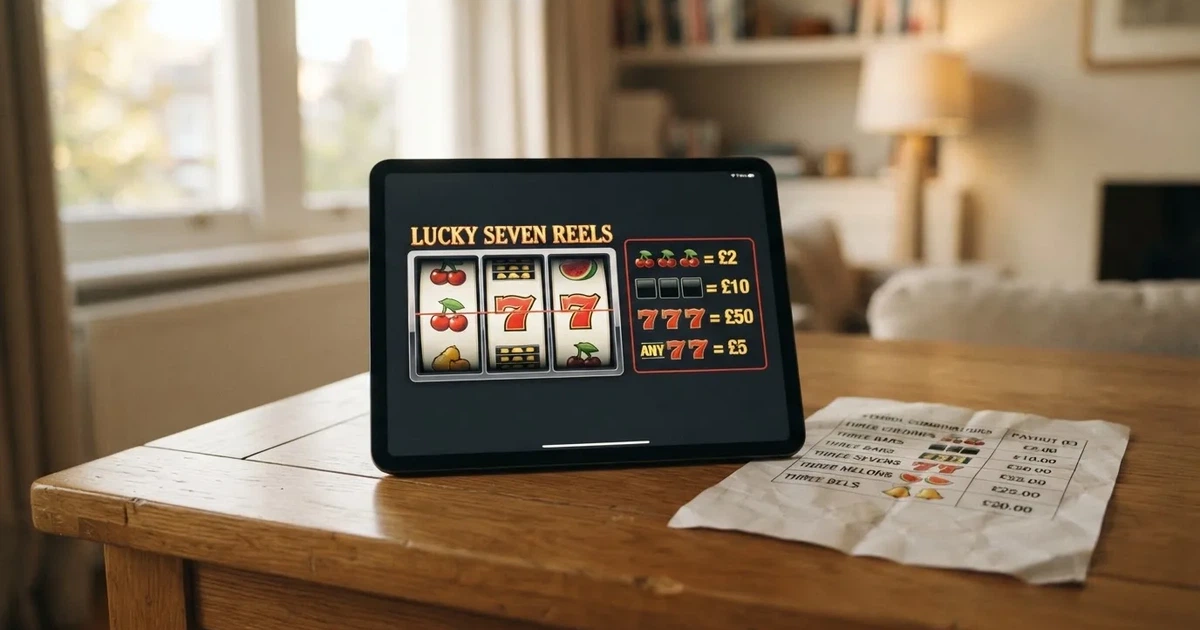
The simplest game on a casino floor is the one most often explained last. Three reels, one payline, a handful of symbols — and behind that clean picture sits a regulator, a stake ceiling, a wagering cap, a self-exclusion scheme, and a payout percentage that the operator has to keep watch on. This page is about what the classic three-reel slot actually costs a player who sits down at one, and what changes once the rule book sits beside it.
Table of Contents
- The shape of the game before the regulator turns up
- What the Gambling Commission register says about who can offer them
- What the regulator actually does to a three-reel slot
- How a player costs a bonus into real money at a £10 offer
- Free play, demos, and what “no registration” actually means
- The paytable, the symbols and the line
- Stakes, deposits and what gets verified
- Self-exclusion, complaints and the player who has stopped
- What the operator list at the bottom of the page covers
- Operator table
- Paddy Power
- Unibet
- Sky Vegas
- kwiff
- bet365
- MrQ
- Midnite
- Virgin Games
- BetVictor
- Grosvenor Casinos
- Reading the comparison as a whole
- Other games the player will meet in the same lobby
- Frequently asked questions
The shape of the game before the regulator turns up
A three-reel slot is what most people picture when they hear the word “fruit machine” — three spinning strips of symbols and a single line across the middle that decides whether anything has been won. Charles Fey, a San Francisco mechanic, built the first automatic payout slot in the 1890s: the three-reel Liberty Bell, paying ten nickels — fifty cents — for three aligned bell symbols. Symbols on those early reels were the same motifs a pub machine still uses today: horseshoes, diamonds, spades, hearts, and the bell. Herbert Mills produced the first copy in 1907, and the basic format has not moved much since.

What changed is what the reels decide. In 1984 the Norwegian mathematician Inge Telnaes patented the use of a random number generator to pick each reel’s stop position, so a symbol could appear on screen more often than the physical reel strip would allow. The strip is a costume; the numbers behind it are the game.
That distinction matters for anyone comparing payout percentages. A three-reel slot is not, on its own, a higher-paying game than a five-reel one. It is a simpler format with fewer paylines, fewer bonus rounds, and a return-to-player that the operator sets and the Gambling Commission has to be able to check. The shape of the reels is one input into the maths; everything else is the operator’s design choice.
Volatility describes how that design plays out for a single session. A low-volatility slot pays smaller amounts more often; a high-volatility slot pays less often and more. A three-reel slot tends to sit toward the lower end of the volatility range, which is part of its appeal — bankrolls last longer per spin than they do on a modern five-reel game with cascading reels and feature buys. That does not make it cheaper in aggregate. The house edge sits underneath both formats and does not care how many reels are spinning.
What the Gambling Commission register says about who can offer them
Real-money three-reel slots in Great Britain are part of “online casino” licensing, which means a site taking pounds from a player in England, Scotland or Wales needs a Commission-issued remote casino operating licence before the first deposit. The Commission’s public register is the test of whether a brand holds one.

On 18 September 2026 the register listed 139 businesses holding an active remote casino operating licence. The same register holds a separate list of domains — each website named against the licence account that operates it — and on that day it carried 1065 active entries and 361 white-label entries. A white-label site trades under another company’s licence, which is why its domain is filed against a parent account on the register; this is one of the easier tells for spotting a brand that has its own licence versus one that runs under someone else’s.
Licence numbers on the register follow a fixed pattern. A remote casino licence number has the form account-R-number-suffix, where the leading six digits repeat the licence holder’s account number and the ‘R’ marks a remote, or online, licence. Anyone who wants to check a brand can match the account number on the licence against the account number on the domain list. If the numbers don’t match, the site is trading on someone else’s licence — and that is the only way the register tells you.
This is also the layer where offshore brands sit outside the frame. A Curaçao, Maltese or Gibraltar licence is not a substitute for a Commission licence; since the Gambling (Licensing and Advertising) Act 2014 any operator taking customers in Great Britain has needed a Commission licence wherever it is based. Providing gambling to people in Great Britain without a Commission licence is an offence under section 33 of the Gambling Act 2005, and the Commission disrupts unlicensed sites through cease-and-desist notices, search-engine delisting and payment and hosting referrals — but it has no power to block them at the ISP. What a player loses on an unlicensed site is protection: no GAMSTOP, no Commission complaints route, no approved alternative dispute resolution.
What the regulator actually does to a three-reel slot
A licensed operator does not just hand a player a game and walk away. The Commission requires operators to measure how each game is performing in real time, comparing the actual return-to-player the game’s randomness is producing against the figure the operator has advertised. If a game’s performance drifts outside an acceptable band the operator has to alert the Commission and submit a key event; the Commission’s annual games testing audits check that these monitoring processes are doing what they are supposed to do. The advertised payout percentage on a slot is, in other words, a number the operator is obliged to defend against the live numbers the game is producing.
The same rule book sets the physical and financial limits of play. Online slots carry a maximum stake per game cycle — £5 for players aged 25 and over (from 9 April 2025) and £2 for players aged 18 to 24 (from 21 May 2025). The lower stake ceiling for the younger age group is tied to a higher average problem-gambling score and to ongoing neurological development, both cited by the government as reasons for the limit. A slot spin may not be faster than 2.5 seconds. Auto-play has been permanently banned since 31 October 2021, on the grounds that it caused players to lose track of what they were doing. Reverse withdrawals — letting a player re-gamble money they had already asked to take out — were banned at the same time.
There is no state-set ceiling on deposits or losses. Instead, since 31 October 2025, the operator has to prompt a player to set a financial limit before the first deposit. Financial vulnerability checks trigger automatically at £150 of net deposits in any rolling 30 days, using public data only. The wider financial risk assessments the Commission announced have not yet come into force; the prompt at first deposit, the spin-speed floor, the stake cap and the vulnerability check at £150 are what a player meets today.
Bonus offers are bounded too. Since 19 December 2025 wagering requirements on casino bonuses have been capped at 10x, and mixed-product bonuses — bet on sport, receive casino spins, that kind of stitch-up — are banned. Credit cards have been banned for gambling since 14 April 2020, including cards routed through e-wallets. Anonymous play is not possible at a licensed site: name, address and date of birth are verified before the first deposit, a rule in force since 7 May 2019.
How a player costs a bonus into real money at a £10 offer
The 10x wagering cap is the cleanest number on the rule book and the easiest to cost into a session. Take a notional £10 bonus at a UK-licensed site under the current cap. The player has to turn the bonus over ten times — £100 of qualifying stakes — before any of the bonus becomes withdrawable. At a £1 stake per spin on a 96% three-reel slot that is 100 spins. At the regulator’s 2.5-second minimum spin interval — which is what every licensed slot has to honour — 100 spins take 250 seconds, or just over four minutes of machine time.
That is the cheapest end of the band. The wagering cap itself is 10x; nothing in the rule says a particular bonus cannot set its multiplier lower, and most will. The band is the rule, the actual figure is the operator’s choice inside it. A bonus that sets a 5x turnover on a £10 offer needs £50 of qualifying stakes; a bonus that adds free spins on top of the cash bonus adds whatever the spins cost on the same wagering terms.
The arithmetic also has a cost in expected loss, which the wagering cap does not address. At 96% return-to-player the house keeps 4p per £1 wagered, so the £100 of required turnover at a £1 stake returns £96 in expectation — a £4 expected loss to clear a £10 bonus. At a £2 stake the turnover clears in half the spins but doubles the house edge per spin, ending at the same £4 expected loss. A bigger bonus costs more in turnover and more in expected loss in roughly equal proportion; the cap on the wagering multiple does not change the percentage, only the number of spins the player has to put through.
None of this is a win. The 96% is a theoretical return over a long run; a single bonus-clear session can finish ahead or behind by a much wider margin than the 4p-in-the-pound average, and the operator is not promising a payout. The cap and the spin-speed floor together set the pace at which the bonus bleeds out; the maths above is what the pace costs.
Free play, demos, and what “no registration” actually means
Three-reel slots are widely available in free-play form, often branded as “no registration” or “no download” — which is true at the demo stage, and stops being true at the point real money enters the game. A demo version is a copy of the game running against play-money balances; it lets a player try the reels, the paytable and the bonus features without registering, downloading software or making a deposit. Demo play does not require identity verification, because no money is moving and no win can be cashed out.
Real-money play, even on a free-spin promotion, is a different act. The Commission requires name, address and date of birth to be verified before the first deposit, and that rule does not relax because the first stake happens to be a free one. The “no registration” wording on a slot listing describes the demo, not the cash game; the cash game still requires an account.
This is where the difference between a free spin from a bonus and a free demo spin becomes concrete. A free demo spin costs nothing, has no real-money win attached and needs no account. A free spin awarded as part of a deposit bonus costs nothing at the point of issue but pays out only in bonus funds, which carry the wagering requirement on the bonus those funds came from; the underlying account is verified, the player has deposited, and the winnings sit inside the bonus’s wagering band. The first is a taster; the second is a marketing hook.
The same rule book governs no-deposit offers. A no-deposit bonus — a small credit or a handful of free spins issued without a deposit — is real-money play: the account is verified, the wins are real, and the same 10x wagering cap applies. The “no deposit” wording covers the cash going in, not the checks coming out.
The paytable, the symbols and the line
The paytable on a three-reel slot is a small object. Three reels, one payline, a row of symbols. The most valuable symbol pays for three of a kind across the line; the lower symbols pay smaller amounts for the same alignment. A wild on a three-reel slot, when present, substitutes for other symbols to complete a line; a scatter on a three-reel slot is rarer than on a five-reel game, because the scatter mechanic exists to pay out on combinations that are not on a payline — and a three-reel game has few positions where that matters.
Three aligned bells on a Liberty Bell paid fifty cents in 1895, and that is the shape of the modern game’s payout model: a small, fixed schedule of wins for symbol combinations, with the highest payout attached to the rarest symbol combination. Modern three-reel slots often carry a progressive jackpot as the headline prize, with the smaller combinations paying the running cost of the spins.
What a paytable does not show is the symbol weighting, which is the Telnaes-era change at work. The strip on the screen can carry ten cherries; the underlying random number generator may give each reel stop a different probability of landing on cherry. The payout percentage is what the operator sets; the symbol weighting is how the operator reaches it. The two are not the same number, and the paytable only describes the first.
The payline is where the simplicity of the format becomes the constraint. A single line across the middle pays on a horizontal alignment of three symbols; some three-reel games add diagonal lines, or a “anywhere” line that pays on three symbols across all three reels regardless of position, but the basic version has one line and that is the whole game. Five-reel slots run dozens of paylines, often with hundreds of “ways to win” combinations, and bonus features triggered by scatters. The three-reel slot is what the five-reel slot evolved away from; the format survives because some players prefer the cleaner read.
Stakes, deposits and what gets verified
The stake ceiling is the regulator’s number, not the operator’s. Online slots at a Commission-licensed site are limited to £5 per game cycle for adults 25 and over, and £2 per game cycle for adults 18 to 24. A “game cycle” is one full spin, including any feature rounds triggered by that spin; the cap is on the stake at the start of the cycle, not on the size of the prize. Most three-reel slots sit well below the cap on their default stake, with the higher stakes available as a player moves up the coin-value settings.
The deposit side has no state-set ceiling. Operators have to prompt a player to set a financial limit before the first deposit, but the prompt is a moment in the signup flow, not a regulatory line on the maximum. The £150 net-deposit rolling-30-day mark is where the financial vulnerability check triggers automatically; the check uses public data only at this stage. Beyond the prompt, the limits a player actually meets are the ones the operator sets in its own responsible-gambling tools — daily, weekly and monthly deposit caps, time-outs, reality checks — which the Commission requires operators to make available.
The verification step is where the deposit ceiling meets the age ceiling. Name, address and date of birth are verified before the first deposit; the rule is in force since 7 May 2019 and applies to every Commission-licensed operator. Anonymous play is not possible at a licensed site; the “no registration” framing only applies to demos.
Self-exclusion, complaints and the player who has stopped
GAMSTOP is the national online self-exclusion scheme and a mandatory condition of every Commission online licence since 31 March 2020. A player can register for six months, one year or five years; the exclusion cannot be cancelled early, and the operator is required to refuse service and redirect the player to support services for the duration. Self-exclusion at GAMSTOP is the single biggest break the regulator offers to a player who has decided to stop.
Beneath GAMSTOP sit the operator’s own tools: time-outs (24 hours to six weeks), deposit limits, reality checks at intervals the player chooses, and the activity statements the operator has to make available on request. The National Gambling Helpline, run by GamCare, and GambleAware sit outside the operator and offer support independently of any site. A player who has self-excluded at GAMSTOP is locked out of every Commission-licensed site for the period; a player who has only set a deposit limit at one operator is bounded only at that operator.
Complaints route the other way. A dispute with a Commission-licensed operator can be raised with the operator first, then escalated to an approved alternative dispute resolution (ADR) provider if the operator’s response is unsatisfactory. The Commission does not arbitrate individual complaints, but it reviews the operator’s ADR performance as part of its licence obligations. A dispute with an offshore brand sits outside this route entirely: no Commission licence, no approved ADR, no Commission complaints process. The Commission’s recourse against unlicensed sites is regulatory, not compensatory; it disrupts the site, it does not repay the player.
What the operator list at the bottom of the page covers
The brands below are taken from the Commission’s public register; each one is filed as a domain against the licence account that operates it. The list is not a ranking. It is a cross-section of remote casino operating licence holders on the register on 18 September 2026, presented so that the licence number, account number and domain status are all visible in one place. None of the brands below carries a separate finding on three-reel slot coverage from the Commission’s own data — the register does not list individual game titles per operator, only the licence and the domains — so a reader who wants the actual three-reel catalogue has to check each site’s lobby.
Several of the brands sit under the same parent licence as a sister brand; Ladbrokes, Coral and Gala Bingo are listed under LC International Limited in the research, for example, and that kind of shared licensee means the brands are not independent operators for the purpose of this list. The Commission register is the only source that resolves which brand sits where; a reader who treats a brand’s site as a separate licence from its sibling’s site is reading the marketing, not the regulator.
A note on the table’s coverage. The “subject support” column carries no data for any brand on this page. The Commission’s public register does not record individual game coverage per operator, and the research carried no operator-by-operator catalogue of three-reel slot titles. What the table can answer, honestly, is which licence and which domain status each brand has; what it cannot answer is which three-reel titles each lobby carries. A reader comparing sites on game range has to do that comparison on the sites themselves.
Operator table
| Brand | Licence holder and GB remote casino licence | Domain status on the register | Subject support |
|---|---|---|---|
| Paddy Power | PPB Games Limited · 039411-R-319335-010 | Active | — |
| Unibet | Platinum Gaming Limited · 045322-R-324275-019 | Active | — |
| Sky Vegas | Bonne Terre Gaming Limited · 065519-R-339675-002 | Active | — |
| kwiff | Eaton Gate Gaming Limited · 044448-R-323408-017 | Active | — |
| bet365 | Hillside (UK Gaming) ENC · 055149-R-331499-004 | Active | — |
| MrQ | Tek Fox Ltd · 060629-R-337532-004 | Active | — |
| Midnite | Dribble Media Limited · 042647-R-321653-022 | Active | — |
| Virgin Games | Gamesys Operations Limited · 038905-R-319430-022 | White Label | — |
| BetVictor | BV Gaming Limited · 039576-R-319370-028 | Active | — |
| Grosvenor Casinos | Rank Interactive (Gibraltar) Limited · 057924-R-334666-005 | Active | — |
The white-label status on Virgin Games is the standout in the list. A white-label site trades under another company’s licence — in this case Gamesys Operations Limited — and the licence holder, not the brand, is the regulated entity. The Commission’s register carries this as a distinct entry from an active domain; a reader who treats Virgin Games and a Gamesys-owned active brand as the same kind of licence-holder is reading the front of the building, not the structure behind it.
Paddy Power
Paddy Power’s licence account is 39411 and the active remote casino operating licence is 039411-R-319335-010, held by PPB Games Limited. Paddypower.com is listed on the public register as an active domain. The brand is one of the larger high-street names to have come through the online licensing regime intact, with the licence-holder entity set up to ring-fence the online operation from the retail bookmaking arm.
For a reader looking for three-reel slots specifically, the relevant test is the site’s own lobby: the Commission’s register confirms the licence, but it does not catalogue individual game titles per operator. The verdict on a brand at this scale is that the regulatory foundation is in place — verified identity checks, GAMSTOP participation, deposit prompts, the 10x wagering cap — and the catalogue question is for the site itself.
Unibet
Unibet’s licence account is 45322 and the licence is 045322-R-324275-019, held by Platinum Gaming Limited. Unibet.co.uk is listed as an active domain on the public register. The .co.uk rather than .com domain is the right one for a Great Britain audience; a Unibet player in London would not be redirected to a non-UK site on this domain.
Platinum Gaming Limited is the Kindred Group’s UK-facing entity. As with Paddy Power, the regulatory groundwork is verified; the three-reel catalogue sits on the site. The brand is on the larger end of the list and tends to carry the major studios’ full ranges, which usually includes at least a handful of three-reel titles.
Sky Vegas
Sky Vegas runs under Bonne Terre Gaming Limited on account 65519, with the licence 065519-R-339675-002. Skyvegas.com is listed as an active domain. The Sky branding sits alongside Sky Betting and Gaming’s broader product set, and the casino operation has historically leaned on a smaller in-house studio catalogue alongside third-party providers.
The brand’s three-reel coverage is again a question for the lobby, not the register. The licence is verified, the regulatory layer is in place, and the site’s game filters are where the catalogue question is answered. Sky Vegas’s product is closer to the slot-led end of the market than the sportsbook-led end.
kwiff
Kwiff runs under Eaton Gate Gaming Limited on account 44448, with the licence 044448-R-323408-017. The register records kwiff as an active domain. The brand’s distinctive feature is its “surprise bet” mechanic on sports, which sits outside the casino vertical; the casino side is a more conventional slot-led product.
The licence verification places kwiff inside the same Commission framework as the larger brands on the list. For a reader comparing three-reel slots, the relevant point is that the regulatory framework applies uniformly — the 10x wagering cap, the spin-speed floor, the GAMSTOP participation, the deposit prompts — regardless of the brand’s marketing hooks.
bet365
Bet365’s licence account is 55149, with the licence 055149-R-331499-004 held by Hillside (UK Gaming) ENC. On the register, bet365 appears as an active domain. The brand is the largest single entry on the list by customer volume, and the UK-facing operation is run through a separate Gibraltar-registered entity that has held a Commission licence for the full duration of the post-2014 regime.
The relevant point for three-reel coverage is the same as for any other brand on the list: the register confirms the licence and the operator’s UK-facing status, but it does not catalogue individual games. Bet365’s casino lobby is among the larger ones in the UK market, which makes it a reasonable starting point for a reader who wants to see what the major studios are offering in the three-reel format.
MrQ
MrQ runs under Tek Fox Ltd on account 60629, with the licence 060629-R-337532-004. The brand is listed as an active domain on the register. MrQ positions itself as a no-wagering-requirements casino — which is a position that has to be read against the 10x cap rather than as an exemption from it.
A “no wagering requirements” offer inside the 10x cap means the operator is choosing the floor of the band rather than the ceiling, not that it is operating outside the rule. That is a relevant distinction for a reader comparing offers: the cap is the maximum the operator may set, and a brand that sets nothing is choosing the most generous position the cap allows, not the most restrictive one.
Midnite
Midnite runs under Dribble Media Limited on account 42647, with the licence 042647-R-321653-022. Midnite.com is listed as an active domain. The brand sits in the newer-wave segment of the UK-licensed market, with a product set that runs casino alongside sports.
The licence and the regulatory framework are the same as every other brand on the list. The newer-wave segment of the market tends to lean on a smaller set of studios, which can mean a thinner three-reel catalogue than the larger brands — but the catalogue question is for the site, not the register.
Virgin Games
Virgin Games sits as a white-label domain on the public register, listed against account 38905 and the licence 038905-R-319430-022 held by Gamesys Operations Limited. Virgingames.com is the only entry on this list flagged as white-label, which means the brand runs under Gamesys Operations’ licence rather than holding its own.
The white-label status is the entry that matters here. The brand’s three-reel catalogue, its customer service operation, its complaint handling and its responsible-gambling tools are all run through Gamesys Operations, which is the regulated entity. A reader comparing Virgin Games to a brand that holds its own licence is comparing two different structural positions in the market; the regulator treats them differently because they are different.
BetVictor
BetVictor runs under BV Gaming Limited on account 39576, with the licence 039576-R-319370-028. Betvictor.com is listed as an active domain. The brand sits in the larger half of the list and has been through the post-2014 licensing changes intact.
The catalogue question for a reader comparing three-reel coverage is again for the site, not the register. The Commission’s framework applies uniformly — GAMSTOP, the 10x wagering cap, the spin-speed floor, the deposit prompts, the financial vulnerability check at £150 — and BetVictor sits inside it on the same terms as every other brand on the list.
Grosvenor Casinos
Grosvenor Casinos runs under Rank Interactive (Gibraltar) Limited on account 57924, with the licence 057924-R-334666-005. Grosvenorcasinos.com is listed as an active domain. The brand is the online arm of the Grosvenor high-street casino chain, and its position in the market is a hybrid one: a land-based casino brand with an online product, sitting under a Gibraltar-registered entity that holds a Commission licence.
The hybrid structure is the standout for a reader comparing brands. A player who already knows the Grosvenor high-street brand will find the same name on the online side, but the licence-holder is Rank Interactive (Gibraltar) Limited, not Grosvenor Casinos Limited or any of the high-street entities. The Commission’s framework still applies — the licence is Commission-issued, the brand is regulated under the same rules as every other entry on this list.
Reading the comparison as a whole
The list above is a regulatory cross-section, not a ranking. Each entry sits inside the same Commission framework, and the differences between brands are mostly the differences a reader would see on the sites themselves: catalogue size, studio mix, brand positioning, the size of the welcome offer and the structure of any ongoing promotions. None of those differences are visible in the register.
What the register does make visible is the structural layer underneath the brand: which entity holds the licence, whether the domain is active or white-label, and whether the licence number matches the account number on the domain. For a reader who wants to verify that a site is what it claims to be, that is the right place to start. For a reader who wants to compare three-reel catalogues, the register is not the source — the lobbies are.
A second observation on the list: every brand is filed against a single licence-holder entity, and several of the larger UK-facing brands sit under parents that also hold other gambling licences. The Commission’s register is the test of which entity is regulated; the brand front of the building is a marketing layer on top. A reader comparing brands by the corporate name above the door is comparing marketing entities, not regulatory ones.
Other games the player will meet in the same lobby
A three-reel slot is rarely the only thing on a UK-licensed casino site. The same lobby carries five-reel slots, table games, live casino tables and, on some sites, crash-style games. A crash game like Spribe’s Aviator — released in 2019, with reported more than 42 million active users across more than 5,000 operators worldwide — runs a multiplier curve that rises from 1.00x until the round randomly crashes, with a player cashing out before the crash to win stake multiplied by current value. The format is multiplayer and rounds last seconds; it is a different mechanic from a three-reel slot, with a different volatility profile and a different stake cadence.
Table games on the same site include baccarat, with the Punto Banco variant developed in 1940s Havana the most widespread form globally. In Punto Banco the casino banks the game at all times and both hands are dealt out according to fixed drawing rules; players make no strategic decisions, which is closer in spirit to a three-reel slot than to a blackjack table. Chemin de Fer, the most popular baccarat variant in France, gives players strategic choices — a different game with the same name.
None of these formats changes the framework. The same stake ceilings apply (the £5 / £2 split for 25+ and 18-24, the 2.5-second minimum spin interval where relevant, the auto-play ban). The same 10x wagering cap applies to bonuses across the casino product. GAMSTOP participation is a condition of the licence, not a per-game choice.
Frequently asked questions
Can I play 3-reel slots without registering for an account?
A demo version of a 3-reel slot can be played without an account at most licensed sites, because no money is moving and no win can be cashed out. Real-money play — even on a free spin promotion tied to a deposit — requires the Commission-mandated identity verification before the first deposit, in force since 7 May 2019, and that means an account.
What is the typical payout percentage on a 3-reel slot?
The theoretical return-to-player is set by the operator and varies by title; the Commission’s rules require operators to monitor actual return-to-player against the advertised figure and to alert the Commission when a game’s performance falls outside the acceptable range. A specific percentage for a specific title is a question for the game’s information page, not the regulator.
Are 3-reel slots available to play online with no deposit required?
Demo play is available without a deposit, and no-deposit bonuses (a small credit or a handful of free spins issued without a deposit) exist at some licensed sites. Both routes still require a verified account; the “no deposit” covers the cash going in, not the identity checks coming out, and no-deposit bonuses carry the same 10x wagering cap as deposit bonuses.
Which 3-reel slots have the highest payout rates?
The highest theoretical return-to-player on any given 3-reel slot is set by the operator and varies by title; the Commission’s register does not catalogue payout percentages by game. The practical test is the game’s own information page, which lists the published RTP figure — and even that figure is a theoretical average over a long run, not a guarantee for any single session.
How is a 3-reel slot different from a 5-reel slot in gameplay?
A 3-reel slot runs three reels and usually a single payline across the middle; a 5-reel slot runs five reels and typically dozens of paylines, often with scatter symbols, bonus rounds and feature buys. Volatility tends to sit lower on 3-reel slots than on the higher-variance 5-reel games, but the house edge underneath both formats is the operator’s design choice rather than a property of the reel count.
Must a site be Gambling Commission-licensed to offer real-money 3-reel slots to UK players?
Yes. Any operator taking customers in Great Britain needs a Commission-issued remote casino operating licence under the Gambling Act 2005, in force since the Gambling (Licensing and Advertising) Act 2014. The Commission’s public register is the test of whether a brand holds one; an offshore licence is not a substitute, and providing gambling to people in Great Britain without a Commission licence is an offence under section 33 of the Act.
Written by the editors at safecasinoguideuk.