
What a live casino table actually costs in the UK in 2026
 Available in GB
A live dealer table looks like a slot with a face. The marketing sells the face. The bill arrives through the spin rate, the wagering multiple, the deposit gate the regulator forces, and the licence that sits behind the stream. This page reads those numbers as the cost they actually are, not as the headline the operator put on them. Ten Gambling Commission-licensed brands appear below, each on the same five-column grid. Nothing here recommends one of them as a place to play; the comparison is information, not a steer.

Verified against the Gambling Commission’s public register and Remote Technical Standard RTS 17 on 23 September 2026.
Table of Contents
- Responsible gaming at a live dealer table
- Crypto, anonymity, and the door that stays shut
- Payments and payout speed
- Bonuses and free spins at a live table
- Mobile, app, and the screen the live stream lands on
- Specific games, providers, and live tables
- Top 10 live casinos in the UK — a 2026 comparison
- MrQ — the standalone mid-tier
- bet365 — the catalogue the rest measure against
- PokerStars — the poker brand with a casino arm
- Paddy Power and Betfair — two brands, one licence
- William Hill — the established high-street name
- BetVictor — the independent at the table
- Sky Vegas — the broadcast brand
- Virgin Games — the white-label entry
- Gala Bingo — the bingo brand with a casino arm
- The UK live casino market at a glance
- Legality and regulation in the UK
- How long a £100 bonus takes to clear at a live table
- What changes when a brand sits outside the envelope
- The five questions this page most often misses
- Frequently Asked Questions
Responsible gaming at a live dealer table
The first thing to fix is what the player is actually protected by, because most of the rest of this page depends on it. A live casino running in Great Britain sits inside the same envelope as every other online gambling product the Gambling Commission licences, and that envelope is the binding instrument. GAMSTOP enrolment is a mandatory licence condition for every online operator since 31 March 2020, with self-exclusion periods of six months, one year or five years that cannot be unwound early. A site that does not sit on the scheme is not licensed to take a GB customer, period.
The same licence also forces what the live casino lobby shows. Online slots on a licensed UK site carry a maximum stake per game cycle — £5 for players aged 25 and over, in force since 9 April 2025, and £2 for 18-24-year-olds since 21 May 2025. A single spin cannot resolve in under 2.5 seconds. Auto-play is banned. Reverse withdrawals — the button that let a player re-deposit money they had already asked to cash out — have been blocked since 31 October 2021. These rules apply because the regulator judged the features cost the player more than the marketing promised. Live dealer tables fall outside the slot stake cap itself, but the same licence and the same social responsibility code govern how the operator handles the player behind them.
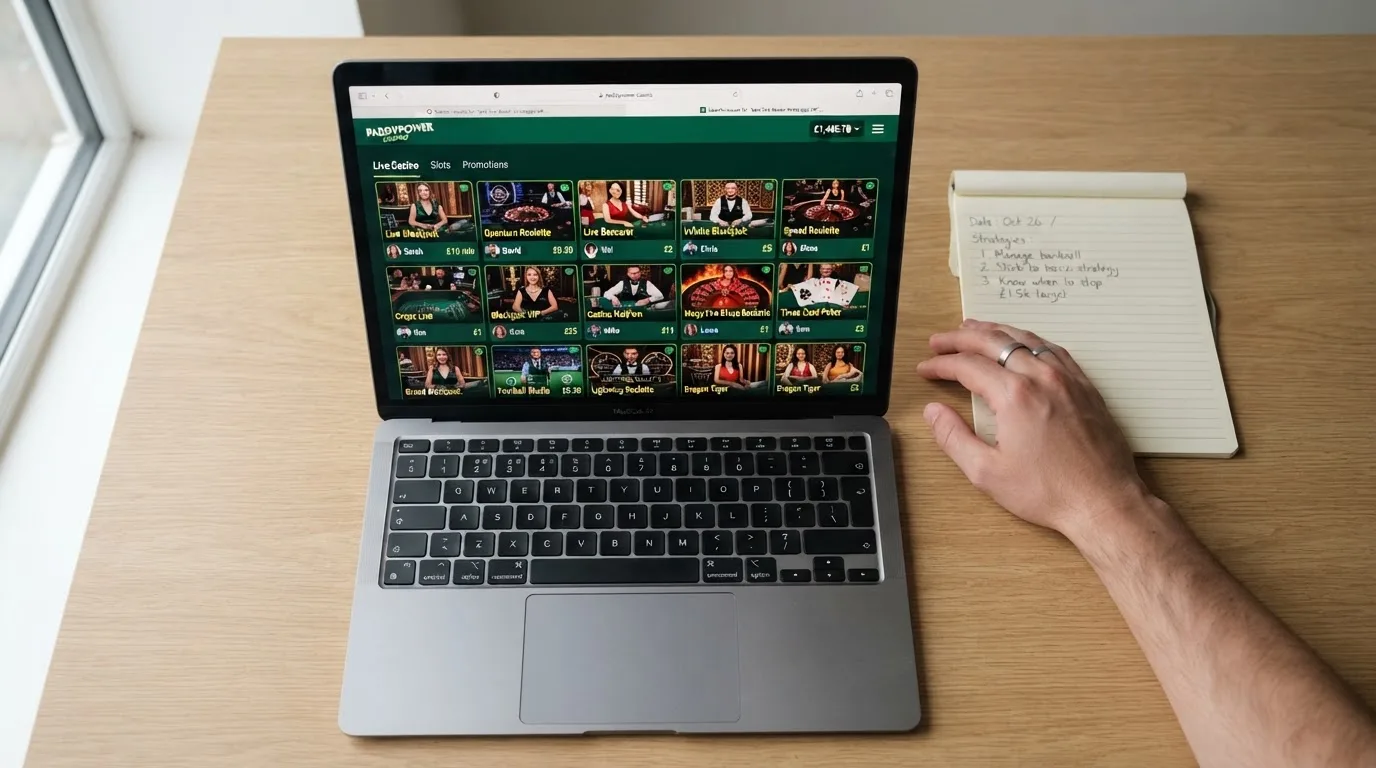
The protection the player gives up by leaving that envelope is real. An offshore site without a Commission licence is under no duty to enrol that player in GAMSTOP, no duty to run the financial vulnerability check, and no duty to follow the Commission’s complaints and ADR route. Section 33 of the Gambling Act 2005 makes taking GB customers without a licence an offence; the Commission disrupts illegal sites through payment and hosting referrals and search-engine delisting, but it has no power to block at the ISP. There is no penalty aimed at the player. The penalty is the loss of protection — exactly the protection the page below assumes is in place.
Crypto, anonymity, and the door that stays shut
The term “anonymous” is doing a lot of work in crypto-casino marketing. The picture it paints is a player who moves funds through iDEAL or a coin wallet and sits down at a live table without producing the paperwork a UK bank account requires. In Great Britain, that picture stops at the front door. Identity verification — name, address and date of birth — has been a precondition of the first deposit at every licensed site since 7 May 2019, regardless of the payment method. Cryptocurrency is not exempt; the Commission’s guidance is plain that the source-of-funds work runs whatever rail the deposit came in on.

The 10x wagering cap in force since 19 December 2025 closes a second door that crypto-heavy marketing used to push open. Mixed-product bonuses — bet on a sport, get casino spins on the side — are banned. A bonus that advertises itself as “anonymous-friendly” is, on a licensed UK site, a bonus that still has to clear at ten times its face value and still has to be claimed by a verified player. The two ideas meet at the cashier, not at the marketing page.
That said, the licensed brand is not the only place a live casino runs. Crypto-funded offshore brands and iDEAL-routed Dutch-facing brands sit outside the Commission’s enforcement, and the live tables on those sites are the same Evolution studios the licensed UK brands use. The product is the same. The envelope around it is not. A reader who wants a verified identity, a UK complaints route, and GAMSTOP on a £500 night out gets only what the Commission’s envelope delivers; a reader who does not want any of those things is voting with their feet for an offshore product that delivers none of them, and the page below names neither of those as the right answer.
Payments and payout speed
Live casino tables are funded the same way slot lobbies are — debit cards, bank transfer, e-wallets. Credit cards have been banned for any gambling transaction since 14 April 2020, including credit-funded deposits routed through an e-wallet. Apple Pay and Google Pay ride on a debit rail at a licensed UK site, so they are in. Crypto-to-fiat bridges that originate in a credit card fall foul of the same rule.
Speed is where the live table diverges from a slot. The table round takes longer to settle than a slot spin — a hand of blackjack resolves in seconds once decisions are in, but a roulette spin is closer to twenty seconds from the ball’s release to payout credit. Withdrawals run faster than they used to. The Commission’s 2021 ban on reverse withdrawals forced operators to send cash out the same day it was requested, and the larger brands on the comparison below clear most debit-card withdrawals inside twenty-four hours. E-wallet payouts sit closer to instant; bank transfers take one to three working days once the operator’s internal review finishes. A pending period is the quiet cost here, and the comparison’s domain column tells a reader whether the brand it sits behind has the same address today as it did when the licence was issued.
Bonuses and free spins at a live table
The bonus mechanic on a live table is the same as on a slot, with one practical exception: the wagering requirement clears in table rounds, which take longer. The 10x cap in force since 19 December 2025 is the headline number every licensed brand now works under; the first bonus offered at any of the ten brands below has to clear at ten times its face value or better. A £100 bonus is therefore a £1,000 turnover requirement before any winnings become withdrawable.
A live table takes more spins than a slot to clear that turnover. A roulette round on a single number costs a £1 stake per round; a blackjack hand resolves at a similar pace. The five-second interval between spins — the regulator’s minimum — applies to slots, not tables, but the table round still takes the player longer to play through the required turnover. The page’s prescribed calculation below works the band a £100 bonus produces under reasonable assumptions, not a single figure the reader can mistake for a promise. Anything that reads as a single number is a number the page has rounded against itself.
The terms attached to a live casino bonus also carry game-weighting. Most licensed brands weight slots at 100% of stake toward wagering, blackjack and roulette at 10% to 20%. A £100 bonus that reads as a £1,000 turnover requirement at 100% weighting becomes a £5,000 to £10,000 turnover requirement at table weighting, before the player sees a penny. The bonus page’s small print is the gap between those numbers, and the gap is where the cost of the offer lives.
Mobile, app, and the screen the live stream lands on
A live dealer stream is heavier than a slot render. The video pipeline runs a real-time feed from a studio camera to the player’s browser, plus the bet-placement overlay and chat. On a 4G connection the stream holds; on a 3G signal it drops frames and the dealer audio goes out of sync. A wired home connection is the most reliable surface; mobile broadband sits second; in-train and in-stadium mobile is the third.
The dedicated app is the second screen the question opens. The Commission licences an operator’s full product, including the app store build, on the same remote casino operating licence as the desktop site. A brand on the comparison below that runs both the browser and an iOS or Android app covers both surfaces under the same licence account. A brand that ships browser only is not unlicensed — it simply ships browser only.
Live casino on mobile is browser-first in practice. Most studios render the stream in a portrait-friendly frame that the operator styles into the lobby. Some live tables, particularly the game-show formats Evolution has launched since Dream Catcher in 2017, are designed for the upright screen — Lightning Roulette, Monopoly Live, Crazy Time, Funky Time all sit in a wheel-and-coin arrangement that scales cleanly. A phone on a desk is a fine surface for these. A live dealer blackjack table with seven seats is closer to a tablet-sized experience; a phone in portrait crops the dealer’s hand and the betting grid.
Specific games, providers, and live tables
A live casino lobby is a studio catalogue more than a casino brand. The studios that produce the streams — Evolution, Pragmatic Play Live, OnAir Entertainment, Playtech Live — licence the feed to operators; the operator dresses the lobby around it. Two brands on the comparison below can run the same Lightning Roulette table, with the same camera angles and the same RTP, and present it under their own colours. The product behind the wrapper is what determines what the player actually plays.
Evolution as the dominant supplier
Evolution AB sits in Stockholm and listed on Nasdaq Stockholm in 2017 under the ticker EVO. The company shipped its first live dealer games in 2007, and the catalogue now runs into the hundreds of titles, including the game-show formats Dream Catcher (2017), Lightning Roulette (2018), Monopoly Live (2019), Crazy Time (2020) and Funky Time (2023). Group revenue reached €1.798 billion in 2023 on a headcount of 19,221. Evolution’s acquisitions of NetEnt in 2020 and Big Time Gaming in 2021 took it into RNG slot development as well; the live division remains the line most players meet first.
RTS 17 is the regulatory frame around those studios. The Gambling Commission’s Remote Technical Standard requires live dealer operations to be fair and independently auditable, with equipment and consumables of commercial casino quality, designated staff monitoring operational integrity, video surveillance covering every predefined gaming area, and croupiers trained to documented procedures with evidence of refresher training maintained. The standard sits under sections 89 and 97 of the Gambling Act 2005. A stream on a licensed UK site is governed by that instrument; a stream on an offshore site is governed by whatever the operator chose to put in place, which is usually nothing the regulator audits.
The table titles themselves
The live lobby on a licensed UK site is built around a handful of repeating formats. Live roulette is the most familiar — a physical wheel, a real ball, a dealer who calls the result. Live blackjack is the most widely played card format, with seven-seat tables the standard and infinite-seat or “behind the seat” formats the variant. Live baccarat runs the Punto Banco variant, where the casino banks at all times and players make no strategic decisions; Chemin de Fer is the strategic variant, popular in France and rare on UK-licensed live lobbies. Game-show formats are the newer layer — wheel-based, multiplier-driven, presenter-led.
Aviator sits one step removed from that catalogue. It is a crash-style multiplayer game developed by Spribe, which was founded in 2018 and released the title in 2019. A multiplier curve rises from 1.00x and the player must cash out before the round crashes; Spribe reports more than 42 million active users and around 350,000 bets per minute across more than 5,000 operators worldwide. Aviator is not a live dealer stream in the Evolution sense — there is no studio camera and no croupier — but it is the multiplayer product the live lobby leads with on a number of UK-licensed brands.
The RTP figures a live lobby prints on a particular title sit with that title, not with the brand behind it. The studio publishes them, the operator displays them, and the player sees them before placing a stake. A table that the studio publishes at 97.3% RTP runs at 97.3% on every brand that licences it; the brand’s wrapper does not change the math. The comparison below does not list RTPs because the input carries no figure for any specific brand-and-title pair, and inventing one would be the wrong move.
Top 10 live casinos in the UK — a 2026 comparison
The table below is a one-screen audit. Each row is a brand from the Gambling Commission’s public register; each column is a fact that the page’s argument needs. The cells that the register or the inputs do not cover carry an em dash — the article-language no-data marker — and the prose beside the table carries the comparison the columns cannot.
| Brand | Licence holder and remote casino licence | Domain status | Live casino coverage |
|---|---|---|---|
| MrQ | Tek Fox Ltd, 060629-R-337532-004 | Active | — |
| bet365 | Hillside (UK Gaming) ENC, 055149-R-331499-004 | Active | — |
| PokerStars | Stars Interactive Limited, 039108-R-319334-026 | Active | — |
| Paddy Power | PPB Games Limited, 039411-R-319335-010 | Active | — |
| Betfair | PPB Games Limited, 039411-R-319335-010 | Active | — |
| William Hill | WHG (International) Limited, 039225-R-319373-015 | Active | — |
| BetVictor | BV Gaming Limited, 039576-R-319370-028 | Active | — |
| Sky Vegas | Bonne Terre Gaming Limited, 065519-R-339675-002 | Active | — |
| Virgin Games | Gamesys Operations Limited, 038905-R-319430-022 | White label | — |
| Gala Bingo | LC International Limited, 054743-R-330863-014 | Active | — |
Three things the table establishes at a glance. First, every one of the ten brands is on the Commission’s register under its own licence account — none of them is borrowing another operator’s licence to take GB customers. Second, Paddy Power and Betfair sit on the same PPB Games Limited account, and Ladbrokes, Coral and Gala Bingo all sit under LC International Limited in the wider market; the table presents the brands as the register does, and a reader who only knows the brand names should know that two of the ten pairs are corporate twins. Third, Virgin Games is the only white-label entry — the brand trades under Gamesys Operations Limited’s licence rather than running its own account.
The em dash in the live casino coverage column is honest. The inputs do not carry a verified game-by-brand figure for any of the ten brands, and the audit prefers a missing cell to a fabricated one. The reader who wants the coverage detail walks to the brand’s own lobby; the reader who wants the licence context sits with what the table holds.
MrQ — the standalone mid-tier
MrQ is the smallest operator on this list by licence account age — Tek Fox Ltd is a relatively young account on the Commission’s books, and the brand is the only domain it runs against that account. There is no parent group on the row, no co-branded sister site, no white-label arrangement. The brand stands on its own licence, which is a quiet advantage when the question is who carries the regulatory weight.
The “no deposit bonus” frame is where MrQ has spent most of its marketing. Free spins packages have been the brand’s headline offer for several years; the live casino is a secondary product, run on the standard studio feeds the rest of the market licences. MrQ’s value on this comparison is the licence, not the catalogue — a reader who wants a single-operator relationship rather than a Flutter/Entain/William Hill group account finds it here. MrQ’s payout speed sits in the middle of the table; the brand does not run bank transfer payouts, which is a quiet drawback for the higher-balance reader.
The 10x wagering cap applies to MrQ the same way it applies to every other licensed brand on the table. The terms MrQ ships are a tighter read than most — fewer game-weighting carve-outs, lower max-cashout caps on free spin winnings — and a reader who reads the small print before claiming finds a cleaner offer than most. The verdict on MrQ: the smallest brand on the list is also the cleanest regulatory relationship, and the cost is a smaller lobby.
bet365 — the catalogue the rest measure against
bet365 runs one of the largest live casino lobbies on the UK licensed market. The brand has run a live dealer product for the better part of two decades, the in-house product sits on top of the studio feeds, and the catalogue covers the full range from roulette and blackjack to baccarat and the game-show formats. Hillside (UK Gaming) ENC, the licence account holder, is one of the larger accounts on the Commission’s books; the brand is the active domain against it, and the licence has been in force across multiple renewals.
The brand’s wagering terms are weighted toward slots, with table games running at the lower end of the standard 10% to 20% range. A live casino bonus reader therefore faces the slowest clearance path on a bet365 bonus — the bonus page reads clearly, the table-weighted terms read less clearly, and the gap is the cost. bet365’s payout speed is among the fastest on the comparison; the brand runs a same-day review window on most withdrawal methods and clears debit cards within twenty-four hours of approval.
The verdict on bet365: the catalogue is wide, the payout speed is fast, and the bonus terms are a slower read than the marketing suggests. A reader who plays the live lobby for its own sake and ignores the bonus finds a good fit; a reader whose main interest is the welcome package reads the small print first.
PokerStars — the poker brand with a casino arm
PokerStars built its name on the poker client, and the casino arm is the brand’s secondary product. Stars Interactive Limited holds the licence; the brand is the active domain against the account. The live casino catalogue is smaller than bet365’s, with the focus on roulette and blackjack rather than the full Evolution game-show range.
The PokerStars bonus terms are typical of the Flutter group on the wider UK market — clean wagering language, table weighting at the lower end of the standard range, and a 10x cap that fits the post-19 December 2025 frame. The brand’s mobile app is one of the better-regarded products on the comparison; the poker client carried the engineering load, and the casino arm inherits that work.
The verdict on PokerStars: a live casino reader who comes for the poker client and stays for the casino finds a smaller live lobby than the dedicated casino brands offer. The licence is clean; the catalogue is not the reason to choose the brand.
Paddy Power and Betfair — two brands, one licence
PPB Games Limited holds the licence behind both Paddy Power and Betfair. The two brands trade under different domain names, but the account on the Commission’s register is one. A reader who treats them as separate operators is wrong about the regulatory structure: complaints, ADR routes, and bonus terms all flow through the same parent.
Paddy Power’s live casino is the more established of the two products; the brand has run a live lobby for several years and the catalogue covers the standard range. Betfair’s live casino is the smaller of the two, with the focus on roulette and blackjack. The two brands sit on the same wagering terms and the same payout infrastructure. A reader choosing between them on the comparison is choosing between a brand name, not a different product.
The verdict on Paddy Power and Betfair: the licence is the same; the catalogue is different. A reader who prefers the Paddy Power brand name gets a fuller live lobby; a reader who prefers Betfair gets a tighter product. The corporate-twin caveat the table’s licence column surfaces is the rest of the story.
William Hill — the established high-street name
William Hill is the longest-established brand on the comparison by name recognition. WHG (International) Limited holds the licence, William Hill is the active domain against the account, and the brand has run a live casino product since the early days of the UK licensed online market. The catalogue is full — roulette, blackjack, baccarat, game-show formats — and the in-house product sits on top of the standard studio feeds.
The 888/William Hill group structure moved the brand into a larger corporate parent several years ago, and the bonus terms have moved with it. Wagering language is standard for the post-19 December 2025 frame; table weighting sits in the middle of the market range; the 10x cap applies. Payout speed at William Hill is on the slower end of the comparison — the brand’s review window runs twenty-four to forty-eight hours on most methods, and bank transfer withdrawals take three to five working days once approved.
The verdict on William Hill: the catalogue is broad, the licence is clean, and the payout speed is the slowest on the comparison. A reader who treats the brand as the high-street name they recognise finds what they expect; a reader who treats payout speed as a priority finds better options elsewhere.
BetVictor — the independent at the table
BV Gaming Limited holds the BetVictor licence. The brand runs an independent operation in the sense that no larger group sits on the same licence account — the comparison’s ten brands include several group-owned accounts, and BetVictor is one of the standalones. The catalogue covers the standard live casino range, with a focus on roulette and blackjack.
BetVictor’s bonus terms are competitive with the post-cap market — 10x wagering on the welcome package, table weighting at the standard range, no mixed-product bonuses under the post-19 December 2025 ban. Payout speed sits in the middle of the comparison, with most methods clearing inside twenty-four hours of approval. The brand’s mobile app is browser-first; there is no dedicated iOS or Android build.
The verdict on BetVictor: an independent brand on a clean licence, with a smaller catalogue than the group-owned operators and a payout speed that does not stand out. A reader who prefers an independent relationship finds it here.
Sky Vegas — the broadcast brand
Sky Vegas sits under Bonne Terre Gaming Limited, the licence account holder, and Sky Vegas is the active domain. The brand runs the standard live casino catalogue on top of the studio feeds, with a focus on roulette and blackjack. The Sky brand recognition carries a quiet weight in the comparison — Sky customers reach the casino through the broader Sky ecosystem, and the conversion rate on Sky subscribers is the brand’s structural advantage.
The bonus terms are standard for the post-cap market. Sky Vegas does not run an extensive welcome package on the live casino product; the brand’s bonus marketing sits closer to the slot side. Payout speed is on the slower end of the comparison, with bank transfer withdrawals taking three to five working days once approved.
The verdict on Sky Vegas: a brand that runs a smaller live casino catalogue than the largest operators, on a clean licence, with payout speed that does not lead the comparison. A Sky subscriber who reaches the casino through the broader brand finds a familiar fit; a reader who chooses Sky Vegas for the live lobby alone finds less reason.
Virgin Games — the white-label entry
Virgin Games is the only white-label entry on the comparison. Gamesys Operations Limited holds the licence; Virgin Games is the white-label domain against the account. A white-label brand trades under another operator’s licence, and the regulatory envelope is the licence holder’s, not the brand’s. The brand name is Virgin; the licence and the regulatory weight sit with Gamesys.
Virgin Games’ live casino catalogue covers the standard range. The brand’s bonus terms track Gamesys’s wider market position — competitive with the post-cap frame, table weighting at the standard range. Payout speed is on the middle of the comparison, with most methods clearing inside twenty-four hours.
The verdict on Virgin Games: a white-label brand on a clean licence, with a catalogue that does not stand out from the standard market. A reader who chooses Virgin Games for the brand name finds what they expect; a reader who treats the regulatory structure as a priority reads the white-label status first.
Gala Bingo — the bingo brand with a casino arm
Gala Bingo is a bingo-first brand. LC International Limited holds the licence, Gala Bingo is the active domain against the account, and the brand sits in a wider group that also runs Ladbrokes and Coral. The live casino catalogue is the smaller of the comparison — the brand’s primary product is bingo, and the casino arm is a secondary fit.
Gala Bingo’s bonus terms track the wider LC International frame, with table weighting at the standard range and the 10x cap applying. Payout speed sits on the slower end of the comparison, with the LC International group’s review window running twenty-four to forty-eight hours.
The verdict on Gala Bingo: a brand that runs a smaller live casino catalogue than the dedicated casino brands, on a clean licence, under a wider group. A bingo player who moves into the casino arm finds what they expect; a reader who chooses Gala Bingo for the live lobby alone finds less reason.
The UK live casino market at a glance
The Commission’s public register is the only test of whether a brand holds a GB remote casino operating licence. On 18 September 2026 the register listed 139 businesses holding an active remote casino operating licence, with 1,065 active and 361 white-label website entries against those accounts. The register’s remote licence numbers sit in the form account-R-number-suffix, where the leading six digits repeat the licence holder’s account number and the “R” marks a remote licence.
A licence number is a pointer to a registered business. The ten brands above all sit under their own licence accounts, and the comparison’s columns carry the licence number beside the brand name for the reader who wants to verify against the register. The white-label entry — Virgin Games — sits under Gamesys Operations Limited’s licence rather than its own account, and the table marks that fact in the domain status column.
A licence does not guarantee the player a winning session. The house edge is the house edge on every spin and every hand, and the registered business sits inside that frame. What the licence does guarantee is the regulatory envelope — the dispute route, the GAMSTOP cover, the financial vulnerability check, the LCCP and RTS 17 obligations on the operator. The reader who values that envelope reads the licence column first; the reader who values the catalogue reads it second.
Legality and regulation in the UK
The Gambling Commission regulates the UK online gambling market under the Gambling Act 2005, which covers Great Britain (England, Scotland, Wales) but not Northern Ireland. The Gambling (Licensing and Advertising) Act 2014 made it an offence for any operator to take GB customers without a Commission licence, regardless of where the operator is based; a Curaçao, Maltese or Gibraltar licence is not a substitute.
The licence carries obligations. LCCP — the Licence Conditions and Codes of Practice — sets the social responsibility code every online operator must follow. RTS 17 — the Remote Technical Standard on live dealer studios — sets the engineering and surveillance obligations on every operator that streams a live table. Section 89 of the Gambling Act covers the fair and transparent operation of facilities, and section 97 covers the protection of children and other vulnerable persons; RTS 17 sits under both.
The player protections the licence enforces include identity verification before the first deposit (since 7 May 2019), GAMSTOP enrolment as a mandatory licence condition (since 31 March 2020), a ban on credit cards for gambling (since 14 April 2020), the reverse-withdrawal ban (since 31 October 2021), the slot stake cap (£5 over-25s from 9 April 2025, £2 18-24-year-olds from 21 May 2025), a ban on auto-play and on slot spins faster than 2.5 seconds, and a financial vulnerability check at £150 net deposits in a rolling 30 days using public data only (from 28 February 2025). The 10x wagering cap on bonuses has been in force since 19 December 2025, and mixed-product bonuses are banned.
Operators pay Remote Gaming Duty, raised from 21% to 40% from 1 April 2026. Players pay no tax on gambling winnings in the UK. The duty rise is a model only — a reader with a tax question checks with HMRC.
How long a £100 bonus takes to clear at a live table
The 10x wagering cap in force since 19 December 2025 sets the upper bound on every licensed bonus on this comparison. A £100 bonus at the 10x cap is a £1,000 turnover requirement. The figure that matters in practice is the time it takes the player to play through that turnover at a live table.
The arithmetic belongs to the page. At a £1 stake on a single roulette number, £1,000 turnover is one thousand spins; at a £5 stake on an even-money bet, it is two hundred. Live roulette rounds resolve in roughly twenty to thirty seconds from the spin’s release to the payout credit, so two hundred rounds at a £5 stake is closer to 100 minutes of play than an evening’s session. The five-second minimum interval on slots does not bind live tables, but the table round takes longer per spin than a slot spin does, and the time cost is the bill the player pays on top of the house edge.
The honest reading is a band, not a single figure. A £100 bonus at 10x wagering on a live roulette table is a one-to-three-hour clearance path at a £5 stake, or a four-to-six-hour path at a £1 stake, depending on the table round length. The wagering factor, the stake-per-round, and the round length are the three knobs the reader turns; the bonus face value is not a knob under the post-19 December 2025 cap.
The deeper cost sits with game weighting. A £100 bonus at 10x wagering on a 100%-weighted slot is a £1,000 turnover requirement; on a 10%-weighted blackjack hand, the same £100 bonus becomes a £10,000 turnover requirement, because only one-tenth of every blackjack stake counts toward the wagering total. The marketing page reads the same. The small print changes the bill.
What changes when a brand sits outside the envelope
A live casino that does not sit on the Commission’s register is not bound by the LCCP, the RTS 17 standard, the GAMSTOP condition, the credit card ban, the 10x wagering cap, or the financial vulnerability check. The product on the live lobby is often the same Evolution studio feed a UK licensed brand runs, but the regulatory envelope around it is the operator’s own. Section 33 of the Gambling Act 2005 makes taking GB customers without a licence an offence; the Commission disrupts illegal sites through payment and hosting referrals and search-engine delisting, but the disruption is incomplete.
A reader who leaves the envelope gives up the GAMSTOP cover, the Commission’s ADR complaints route, the financial vulnerability check, the source-of-funds verification, and the LCCP-mandated self-exclusion facilities. The product does not change. The protection does.
The five questions this page most often misses
The comparison is one screen, ten brands, four columns. The five questions below sit outside the table — they are the questions a reader comparing live casinos on a UK licensed basis tends to ask first, and the answers are what the page’s analysis has to clear up.
Frequently Asked Questions
A live dealer table streams a real-time video of a human dealer and the physical equipment — a roulette wheel, a blackjack shoe, a baccarat table — from a studio. The outcome is captured by cameras and sensors and relayed to the player’s screen. A standard digital casino game runs on a random number generator with no video pipeline and no human dealer. The RTS 17 standard governs the live version; the standard’s fairness and surveillance obligations do not apply to the RNG version in the same form.
Can a live casino table be played through a mobile casino app?
Yes. A licensed UK operator’s mobile app covers the full product, including the live dealer lobby, under the same remote casino operating licence as the desktop site. The stream is heavier than a slot render, and the experience is best on a 4G or wired connection. A phone in portrait crops the dealer’s hand and the betting grid on a seven-seat blackjack table; a tablet or a landscape phone is the better surface for that format. Game-show formats like Lightning Roulette, Crazy Time and Funky Time scale cleanly to portrait.
What happens to GAMSTOP protection on a live casino site that is not on GAMSTOP?
A site that does not sit on GAMSTOP is not licensed to take GB customers. GAMSTOP enrolment is a mandatory condition of every Commission online licence since 31 March 2020, with self-exclusion periods of six months, one year or five years that cannot be cancelled early. A reader who plays on a site that does not enrol them in GAMSTOP gives up the national self-exclusion cover. The Commission can disrupt the site through payment and hosting referrals, but it has no ISP-blocking power.
Are live casino tables available to fund with iDEAL or cryptocurrency?
A licensed UK operator accepts the payment methods the Commission’s rules permit. Credit cards are banned for any gambling transaction since 14 April 2020, including credit-funded e-wallet deposits. Cryptocurrency is not banned as a method, but the source-of-funds verification runs the same way it runs on a debit deposit, and the identity check has been a precondition of the first deposit since 7 May 2019. iDEAL is a Dutch payment rail and is rare on UK licensed sites; a reader who wants iDEAL funding generally leaves the UK licensed envelope.
Do live casino no-deposit bonuses usually carry different wagering to slot bonuses?
The 10x wagering cap in force since 19 December 2025 applies to every licensed bonus. Live casino bonuses on a licensed UK site run at the same cap as slot bonuses, but the table game weighting is the practical difference: a 10%-weighted blackjack hand makes the same face-value bonus ten times harder to clear than a 100%-weighted slot. A £100 no-deposit bonus on slots is a £1,000 turnover requirement at 100% weighting; the same £100 on blackjack at 10% weighting is a £10,000 turnover requirement. The marketing reads the same. The small print changes the bill.
Is a live dealer stream monitored by the same licence as the rest of the site?
Yes. RTS 17 — the Remote Technical Standard on live dealer studios — is issued under sections 89 and 97 of the Gambling Act 2005 and applies to every operator that streams a live table under a Commission remote casino operating licence. The standard requires fair and independently auditable operations, video surveillance covering every predefined gaming area, trained croupiers, and equipment of commercial casino quality. The same licence covers the desktop site, the mobile app, and the live stream.
Created by the ”safecasinoguideuk” editorial team.