What an online craps table actually costs in the UK
 Available in GB
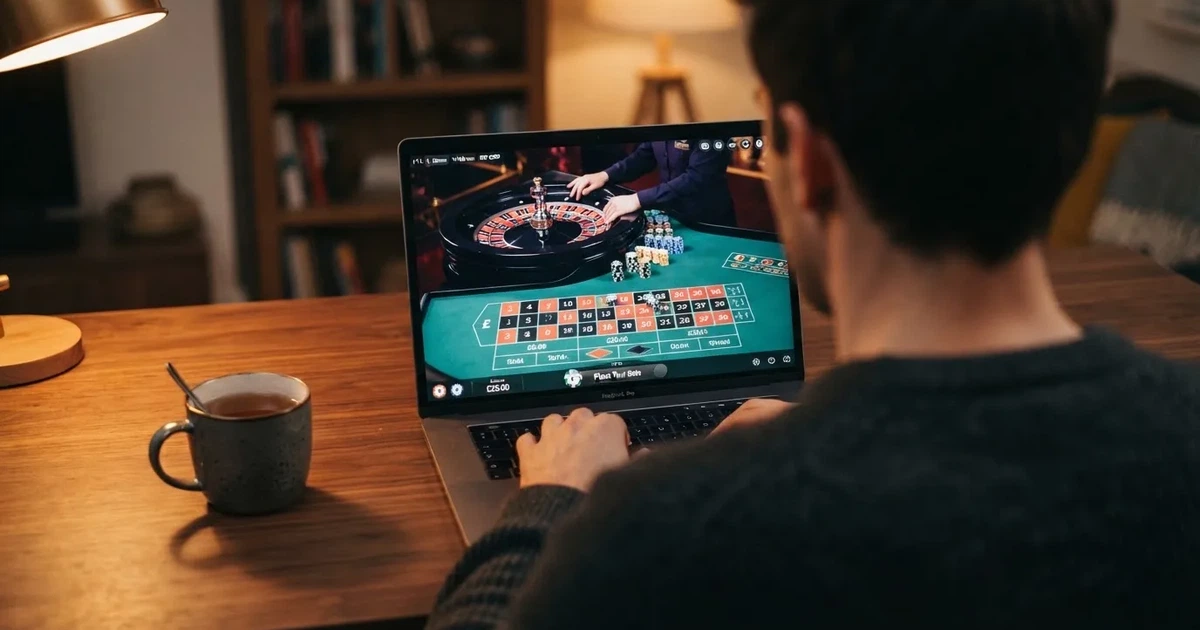
The first thing to settle on a page like this is the cost question, because every other shelf sits underneath it. At a UK-licensed site, the table itself is honest in a specific way: craps runs on fixed mathematics, the bets either carry a house edge or pay at true odds, and the chip you hold behaves the same way the chip in a London casino does. What is not fixed is everything around the table, and the marketing around craps bonuses tends to concentrate exactly there, where the arithmetic is least visible. That gap between the table and the offer is what this page closes.
The data below reflects the state of the Gambling Commission’s public register on 23 September 2026, cross-checked against the register’s downloadable CSV.
Table of Contents
- Responsible gambling: the rules every craps player sits under
- Crypto, e-wallets, and the anonymity question
- Craps bonuses: what the offer costs, not what it advertises
- Mobile and app access to craps
- The craps game itself: paytable, providers, live tables
- The UK licensed-casino landscape for craps
- How the licensed set actually compares
- The legal frame: what a Gambling Commission licence obliges the operator to do
- What the page leaves on the table
- Frequently asked questions
Responsible gambling: the rules every craps player sits under
A craps session in the UK sits inside a regulatory frame that the casino does not control. GAMSTOP registration is a mandatory condition of every online operating licence since 31 March 2020, which means that self-excluding from one site excludes you from all of them, and that the six-month, one-year and five-year periods cannot be cut short. The deposit side is similarly fixed in shape, even where the number is not. Since 31 October 2025 operators must prompt every customer to set a financial limit before the first deposit. Since 28 February 2025 the operator must run a financial vulnerability check once net deposits cross £150 in a rolling 30 days, using public data. Both checks belong to every UK-licensed site on the ranking below.

The slot rules that have filled the safer-gambling headlines do not apply to craps. The £5 maximum stake per game cycle for players aged 25 and over and £2 for 18-24, in force since 21 May 2025, are slot-specific. The 2.5-second minimum spin interval, the permanent auto-play ban, and the losses-disguised-as-wins ban are all slot-specific. The craps player enjoys none of those defences and does not need to; the dice throw takes what it takes, and the table cannot auto-play a pass line. The deposits-side protections still apply.
Where to get help if a craps session stops being entertainment: the National Gambling Helpline (GamCare) and GambleAware are the two national routes. GamCare runs the helpline; GambleAware funds treatment and education. GAMSTOP itself is a self-exclusion mechanism, not a treatment service, and it works only at UK-licensed sites. A site outside the Commission’s reach will not see a GAMSTOP exclusion and has no obligation to honour it. The player on such a site loses the protection the regulator provides; they do not gain any substitute.
Crypto, e-wallets, and the anonymity question
“Anonymous” is a word that travels badly in UK gambling. Under the Gambling Commission’s identity rules, in force since 7 May 2019, an operator must verify name, address and date of birth before the first deposit or any play. This applies to every payment method the operator accepts, including cryptocurrency, e-wallets and bank transfers routed through third parties. The means of payment does not relax the means of identification.

This is the single point where the crypto-casino language and the UK regulatory language collide. The crypto-friendly framing — no card details, no banking trail, wallet-to-casino transfer — describes the payment leg accurately. It does not describe the onboarding leg. A UK-licensed operator still has to run the same KYC checks on a Bitcoin deposit that it runs on a debit-card deposit, because the licence requires it. A player who came to a craps table because a casino advertised itself as crypto-friendly will still need to upload a photo ID and a proof of address before any withdrawal. The marketing word and the licence obligation are not the same.
A second collision is on credit. UK gambling operators have been banned from accepting credit cards since 14 April 2020, including credit-card-funded e-wallet loads. Bitcoin and other cryptocurrencies are not credit, and an unlicensed operator may still accept them; a UK-licensed one operates within the same KYC frame regardless. The choice that matters is whether a site is on the Commission’s register at all, not whether it advertises a particular payment rail.
Craps bonuses: what the offer costs, not what it advertises
A bonus is a turnover requirement before any of it is yours. The shape of the requirement changed on 19 December 2025: wagering requirements on bonuses are now capped at 10x, and mixed-product offers that bundle a sports bet with casino play (or vice versa) are no longer permitted at UK-licensed sites. The 10x cap applies to the bonus amount. The cap is also a ceiling, not a floor — an offer can still sit below it, and the better bonuses on the market do.
The arithmetic on any craps-eligible bonus is straightforward enough to walk through once. A £100 bonus at 10x wagering means £1,000 of qualifying play before withdrawal, the qualifier being that the bonus is the figure that multiplies, not the deposit. At a £5 craps bet on the Pass Line that is roughly 200 dice decisions — not 200 spins of a slot, but 200 come-out-or-point sequences, some resolved on the first roll, others standing on a point. The math behind the bets themselves is the craps math (1.41% on the Pass Line, 0% on the Odds bet behind it); what the bonus adds is the requirement to perform that math enough times to clear the wagering before withdrawal.
The expected loss for that £1,000 of Pass Line play is £1,000 × 1.41% = £14.10, before any seven-out recovery. Craps is one of the gentler table games on the player side, and the expected cost of clearing the bonus on Pass Line is closer to £14 than to the £100+ a slot clearing would cost at the same stake. This is not a recommendation; it is the arithmetic of where the edge sits, and the edge is what the offer costs.
What to read before claiming any bonus: whether the offer counts craps at all (some welcome packages restrict eligible games to slots or live-dealer titles only), the maximum single-bet stake during the wagering period, and any max-cashout cap on a bonus win. These three lines determine whether the bonus is worth the arithmetic, and a 10x cap on wagering does not exempt any of them.
Mobile and app access to craps
Craps on a UK-licensed site runs through two routes: a browser-based instant-play table optimised for mobile browsers, or a dedicated casino app on iOS or Android. The live-dealer versions of craps, where they exist, sit within the same app infrastructure as the rest of the live casino.
The browser route does not need a download and uses the same RNG or live-stream layer as desktop play. Where a UK operator offers both routes, both routes are subject to the same KYC, the same GAMSTOP check, and the same deposit-limit prompt before the first deposit. A dedicated app adds push-notification handling, which is itself a gamble-management surface — reality checks, session-time reminders and deposit-cap nudges are delivered through the same channel. Auto-play is banned for slots and is not a feature on a craps table; the table simply waits for the next decision.
Two practicalities for the craps player on a phone. First, the live-dealer craps table is bandwidth-heavy relative to a standard slot — the studio stream runs continuously, with a tutorial overlay in some implementations. A 4G connection handles it; a flaky hotel Wi-Fi does not. Second, the betting layout is dense. On a phone in portrait orientation the Pass Line and the field are fine; the proposition bets in the centre of the table compress, and the player either narrows the bet set or rotates to landscape. This is not a licence issue; it is a usability one, and it is worth a few minutes with the table before any real-money session.
The craps game itself: paytable, providers, live tables
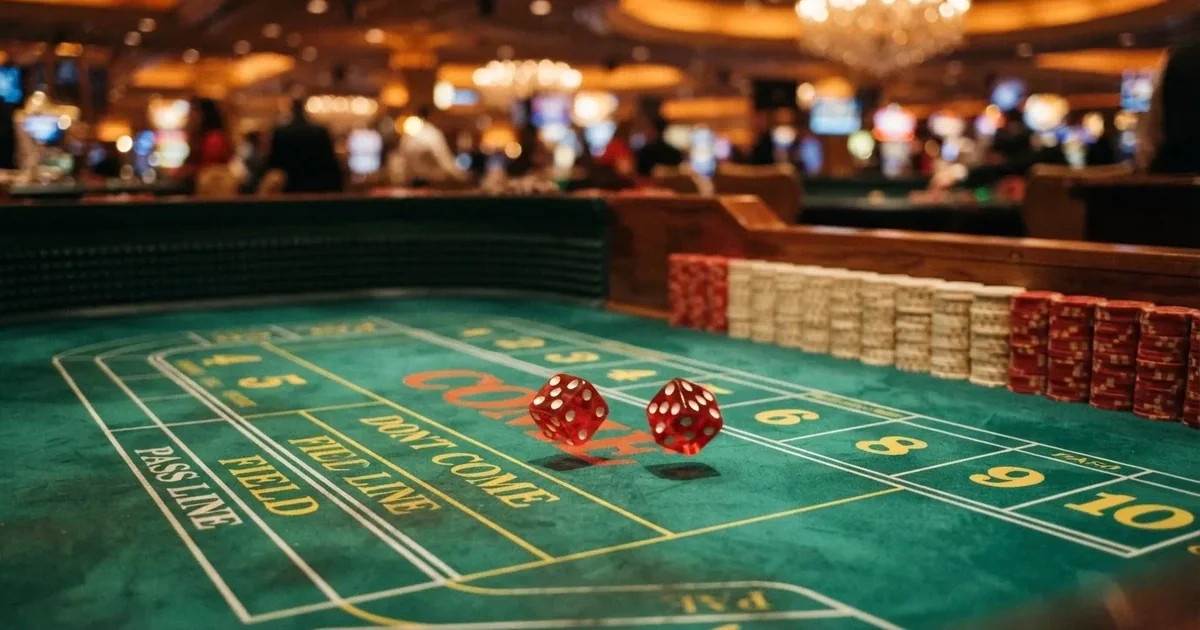
Craps developed in the United States as a simplification of an older English dice game called Hazard; the name “craps” comes from London slang “crabs,” which referred to the losing rolls of 2 and 3 in Hazard. The modern betting layout — including the Don’t Pass wager that lets the house back either side of the shooter — was introduced around 1907 by the Philadelphia dice-maker John H. Winn, and his arrangement let the casino profit whichever way a bet went, removing the temptation to use controlled dice. The table itself is a U-shaped layout with mirrored betting areas at each end and a pyramid-textured wall (the “pyramid”) that randomises the dice as they are thrown.
The bets that matter for the UK online player:
- Pass Line: a wager that the shooter wins. House edge 1.41%. The bet wins on a come-out roll of 7 or 11, loses on 2, 3 or 12, and “stands” on any other number until the shooter either makes that number (the Pass Line wins) or sevens-out (the Pass Line loses).
- Don’t Pass: the mirror bet, that the shooter loses. House edge 1.36%. Wins on a come-out roll of 2 or 3, ties on 12, stands on the point, wins if the shooter sevens-out before making the point.
- Come / Don’t Come: the same pair of bets applied after the point is established. The mathematics are identical to the line bets.
- Odds bet: placed behind a Pass or Don’t Pass line bet at true mathematical odds. The Odds bet carries a 0% house edge. It can only be made alongside an existing line bet.
- Place bets on 4, 5, 6, 8, 9, 10: the player picks a number and is paid when it rolls before a seven. House edge varies by number, from 1.52% on 6 and 8 to 6.67% on 4 and 10.
- Field: a one-roll bet that the next roll is 2, 3, 4, 9, 10, 11 or 12. House edge around 2.78% on the standard 2:1 payout on 12.
- Proposition bets in the centre of the table: any seven, any craps, hardways, the horn. House edge ranges from around 4% to over 16% on individual prop bets. This is where the table’s worst mathematics live.
The Online Craps (RNG) titles that show up on UK-licensed sites are typically single-player, automated, with the dice roll resolved by a random number generator. The live-dealer alternative is rarer but exists. Evolution’s Live Craps, in production at UK-licensed sites that carry Evolution’s live suite, is set in a speakeasy-themed studio and includes a built-in interactive tutorial plus an “Easy Mode” aimed at players new to the game. The game follows the same Come-Out-then-Point structure as a physical table, with some bets resolved on a single roll and others standing across several rolls.
The studio choice matters less than the paytable. Any craps table that hides its house edge, or that pays less than true odds on the Odds bet, is one to leave alone — a single deviation on the Odds bet moves the bet from 0% house edge into something materially worse, and the player has no way to know from the chip alone.
The UK licensed-casino landscape for craps
The UK online casino market sits on a public register, and the register is the test. On 18 September 2026 the Gambling Commission’s public register held 139 businesses holding an active remote casino operating licence; the register can be searched online and downloaded in full as CSV or Excel. The domain list records each website against the licence account that runs it, with a status of Active, Inactive or White Label; on that same date the list held 1,065 active and 361 white-label domain entries, the white-label sites trading under another company’s licence. A remote casino licence number has the form account-R-number-suffix where the leading six digits repeat the licence holder’s account number and the “R” marks a remote (online) licence.
Every brand on the ranking below is taken from that register. The order of the brands is editorial, drawn from the research file, and the page does not rank one operator above another for playing craps specifically — research carries no craps-specific comparison data between brands, and a page that pretended otherwise would be inventing it. What each entry does carry is the licence data, the domain’s register status, and what the page has actually been able to establish about the brand.
Grosvenor Casinos
Grosvenor Casinos is active (account 57924, Rank Interactive (Gibraltar) Limited, 057924-R-334666-005). As part of the Rank group, it benefits from a continuous operator presence.
Betfred
Betfred (Betfred.com) operates as an active domain (account 39544, Petfre (Gibraltar) Limited, 039544-R-319290-010). The brand’s craps titles follow standard operator KYC and studio paytable rules.
32Red
32Red (32red) is active under Platinum Gaming Limited (account 45322, 045322-R-324275-019). As a casino-led brand, its game library is extensive, with craps titles within its live-dealer suite.
BetVictor
BetVictor (Betvictor.com) is active (account 39576, BV Gaming Limited, 039576-R-319370-028). The brand’s casino catalogue focuses on core gaming, with craps availability depending on its current studio partnerships.
William Hill
William Hill is active under WHG (International) Limited (account 39225, 039225-R-319373-015). The brand’s heritage and live-casino suite are central to its online offering.
Virgin Games
Virgin Games is a white-label domain of Gamesys Operations Limited (account 38905, 038905-R-319430-022). As a white-label, the platform and licensing infrastructure are managed by Gamesys.
Ladbrokes
Ladbrokes (Ladbrokes.com) is active under LC International Limited (account 54743, 054743-R-330863-014). This licence holder manages several major brands; the craps offering aligns with the group’s wider catalogue.
Paddy Power
Paddy Power is active under PPB Games Limited (account 39411, 039411-R-319335-010). The brand sits on the Commission’s register, sharing its licence with Betfair.
Betfair
Betfair (Betfair.com) is active under the same PPB Games Limited licence as Paddy Power. Its casino catalogue is distinct from its sibling brand, with craps availability varying by studio agreement.
Jackpotjoy
Jackpotjoy (Jackpotjoy.com) is active under Gamesys Operations Limited (account 38905, 038905-R-319430-022). It shares its licensing and platform infrastructure with Virgin Games.
How the licensed set actually compares
The table below sets the ten brands side by side on what the register establishes. It is not a craps-feature comparison: research carries no comparison of craps availability, craps bonus terms or craps payout speed across these brands. The columns that follow are the columns the register answers.
| Brand | Licence holder | GB remote casino licence | Domain status on the register | Subject support |
|---|---|---|---|---|
| Grosvenor Casinos | Rank Interactive (Gibraltar) Limited | 057924-R-334666-005 | Active | — |
| Betfred | Petfre (Gibraltar) Limited | 039544-R-319290-010 | Active | — |
| 32Red | Platinum Gaming Limited | 045322-R-324275-019 | Active | — |
| BetVictor | BV Gaming Limited | 039576-R-319370-028 | Active | — |
| William Hill | WHG (International) Limited | 039225-R-319373-015 | Active | — |
| Virgin Games | Gamesys Operations Limited | 038905-R-319430-022 | White Label | — |
| Ladbrokes | LC International Limited | 054743-R-330863-014 | Active | — |
| Paddy Power | PPB Games Limited | 039411-R-319335-010 | Active | — |
| Betfair | PPB Games Limited | 039411-R-319335-010 | Active | — |
| Jackpotjoy | Gamesys Operations Limited | 038905-R-319430-022 | Active | — |
| Bet | House Edge | Note |
|---|---|---|
| Pass Line | 1.41% | Base wager |
| Don’t Pass | 1.36% | Mirror wager |
| Odds Bet | 0.00% | Requires existing bet |
| Place 6/8 | 1.52% | Common number bet |
| Field | 2.78% | One-roll bet |
The absence in the rightmost column is itself the information. A craps player comparing these ten sites cannot, on the evidence this page carries, decide between them on the craps offering alone. They can decide between them on the licence holder (and the corporate parent that owner sits within), on the domain status, and on every other feature of the casino product that the operator’s own pages publish. The craps-specific decision — which of these ten sites has the live-dealer table today, which has the RNG variant, which excludes craps from its welcome bonus — is a question that changes weekly and is best settled by opening the casino’s live lobby rather than by reading any ranking page.
The legal frame: what a Gambling Commission licence obliges the operator to do
The regulator is the Gambling Commission (UKGC), sponsored by DCMS, under the Gambling Act 2005, which covers Great Britain — England, Scotland and Wales, not Northern Ireland. Since the Gambling (Licensing and Advertising) Act 2014 any operator taking customers in Great Britain has needed a Commission licence wherever it is based; a Curaçao, Maltese or Gibraltar licence is not a substitute, and the licence number on the Commission’s public register is the test of whether a brand holds one. The minimum age is 18, and name, address and date of birth are verified before any first deposit or any play. Online casino is licensable, and the public register is the whole test of whether a brand holds a licence.
The credits-and-deposits frame is mostly on the player side now. Credit cards are banned for gambling since 14 April 2020, including credit-card-funded e-wallet loads. Since 19 December 2025 wagering requirements on bonuses are capped at 10x and mixed-product bonuses (a sports bet bundled with casino spins) are banned. The slot rules — the £5 (£2 for 18-24) maximum stake per game cycle, the 2.5-second minimum spin interval, the auto-play ban and the losses-disguised-as-wins ban — are slot-specific, not table-specific. The craps player does not get those defences and does not need them at the table itself.
Player protection runs through GAMSTOP, GamCare and the National Gambling Helpline, with GambleAware funding treatment and education. Financial vulnerability checks at £150 net deposits in a rolling 30 days have been in force since 28 February 2025; they use public data only. Wider financial risk assessments have been announced but are not yet in force as of this writing. Anonymous play is not possible at a licensed site — the KYC regime catches any wallet, any deposit method, any pseudonym.
What the licence does not do is protect a player on an unlicensed site. Providing gambling to people in Great Britain without a Commission licence is an offence under section 33 of the Gambling Act 2005. The Commission disrupts illegal sites through cease-and-desist notices, search-engine delisting and referrals to payment and hosting providers, but has no ISP-blocking power. No penalty is aimed at the player; what the player loses on an unlicensed site is protection — no GAMSTOP, no Commission complaints route, no approved ADR. The player on a Curaçao-licensed site trading in sterling to UK customers is unprotected in exactly the ways the Commission exists to provide protection.
On tax, players pay no tax on gambling winnings in the UK; operators pay Remote Gaming Duty, raised from 21% to 40% from 1 April 2026. The model only — readers should check with HMRC for anything specific to their own position.
What the page leaves on the table
Two absences the reader should know about. First, no figure on this page compares craps paytables, bonus eligibility or payout speed between the ten licensed brands, because research carries no such figures. Where the table above shows an em dash, the absence is a research result, not an oversight. Second, no claim on this page tells the reader which operator to play at; the page describes the licences, the rules and the math, and stops short of recommending one of the ten brands to the reader.
The cost question this page opened with is the cost the player can do something about. The 1.41% house edge on the Pass Line is fixed by the dice and is paid by every shooter. The 0% on the Odds bet is available at every table that offers it. The 10x wagering cap on bonuses is a Commission rule from 19 December 2025 and is the same at every licensed site. The £150 financial-vulnerability check is a Commission rule from 28 February 2025 and is the same at every licensed site. What is not fixed is the catalogue — which of these ten brands runs Evolution’s Live Craps today, which runs the RNG alternative, which has a craps-eligible welcome bonus — and that is the question a player has to settle by opening the live lobby on the day.
Frequently asked questions
How do craps payouts work at a licensed UK online casino?
A craps payout is determined by the bet, not by the casino. Pass Line pays 1:1 and carries a 1.41% house edge. Don’t Pass pays 1:1 with a 1.36% edge. The Odds bet, placed behind a Pass or Don’t Pass wager, pays at true mathematical odds with a 0% edge, but can only be made alongside an existing line bet. Place bets on 6 or 8 pay 7:6 with a 1.52% edge; on 5 or 9 they pay 7:5 with a 4% edge; on 4 or 10 they pay 9:5 with a 6.67% edge. Field pays 1:1 on most numbers and 2:1 or 3:1 on 2 or 12, depending on the table.
Is online craps available as a live-dealer game or only as a digital table?
Both. RNG craps tables, where a random number generator resolves each dice roll, are widely available on UK-licensed sites. Live-dealer craps is rarer but exists — Evolution’s Live Craps runs at licensed sites that carry the Evolution live suite, set in a speakeasy-themed studio with a built-in interactive tutorial and an Easy Mode for new players. The live game splits each round into a Come-Out roll and a Point roll, with some bets resolved on a single roll and others standing across several rolls, exactly as on a physical table.
Can craps be played through a casino app on a phone?
Yes, where the licensed operator offers a dedicated iOS or Android app and has craps in its mobile catalogue. Browser-based instant play works on any modern phone browser and does not require a download; live-dealer craps in particular runs through both routes. The mobile experience delivers the same KYC, GAMSTOP check and deposit-limit prompt as the desktop product, with reality checks and session-time reminders routed through the app’s push-notification channel.
Do UK craps tables use the same bet types as a physical casino table?
Yes. The Pass Line, Don’t Pass, Come, Don’t Come, Odds, Place, Field and the centre-table proposition bets are all standard on UK-licensed craps tables, both RNG and live-dealer. The Odds bet pays at true mathematical odds on a properly configured table (0% house edge). The proposition bets in the centre carry the same wide house edges they do on a physical table — from around 4% on the better bets to over 16% on the worst — and the player is best served by leaving most of them alone.
What bonus terms usually apply when a bonus can be used on craps?
Since 19 December 2025 UK-licensed sites cannot offer a bonus with wagering requirements above 10x. Mixed-product bonuses — a sports bet bundled with casino play — are banned. A £100 craps-eligible bonus at 10x wagering means £1,000 of qualifying play, with the expected loss on Pass Line play around £14 over the clearing period, before considering max-cashout caps and per-bet stake limits during wagering. The three lines worth reading on any craps-eligible offer are: game eligibility (does craps count?), the maximum single bet during the wagering period, and any max-cashout cap on bonus-derived winnings.
Are craps tables offered by crypto-friendly casinos different from standard ones?
The craps game itself is the same. The paytable, the house edge and the bets are set by the studio, not by the payment method. What differs is the onboarding. Under Gambling Commission identity rules in force since 7 May 2019, a UK-licensed operator must verify name, address and date of birth before any first deposit or any play, regardless of whether the deposit is in pounds, euros or Bitcoin. Crypto-friendly is a payment-rail description, not an identity-relaxation description, and the two are routinely confused.
Published by the safecasinoguideuk team.